What Are Stablecoins? USDT, USDC, Crypto Payments and the Risks Explained
Crypto Beginner Guide
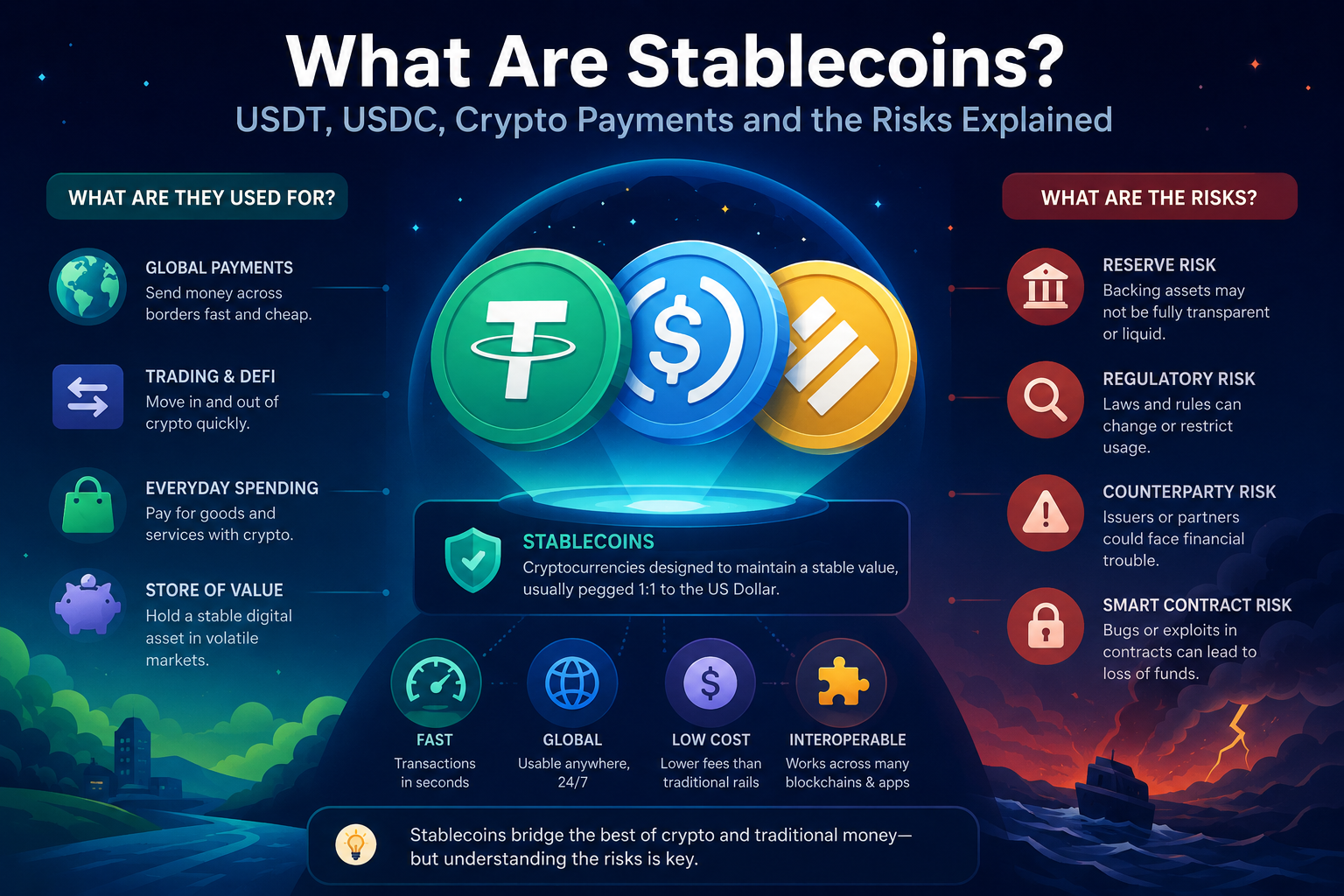
Stablecoins are cryptocurrencies designed to keep a stable value, usually by tracking another asset such as the US dollar. They are widely used for crypto trading, payments and decentralised finance, but they are not risk-free.
Many beginners hear names like USDT, USDC and stablecoins without fully understanding what they are. They can look simple because one token is often designed to stay close to one dollar, but the risks are more complicated than the name suggests.
Stablecoins are important because they act like a bridge between traditional money and crypto markets. Traders use them to move in and out of crypto positions, exchanges use them as trading pairs, and some people use them for faster digital payments.
This guide explains what stablecoins are, how they work, why people use them, what USDT and USDC mean, what depegging is and which risks beginners should understand before using them.
What you will learn
- What stablecoins are
- Why stablecoins exist
- How USDT and USDC work
- What a dollar peg means
- What stablecoin reserves are
- Why stablecoins can lose their peg
- How stablecoins are used in crypto payments
- How stablecoins are used in DeFi
- The main risks beginners should know
- How to use stablecoins more safely
Important:
This article is for educational purposes only. It is not financial advice, investment advice, or a recommendation to buy cryptocurrency. Cryptoassets can be high risk, stablecoins can lose value, and you should never put in money you cannot afford to lose.
Useful official resources
Helpful outbound links:
FCA: Cryptoassets information
FCA: Cryptoassets and stablecoins
U.S. Treasury: Report on Stablecoins
Federal Reserve: Stablecoins and financial stability
Related guides on The Trading Journal
Helpful internal links:
What Is Bitcoin and How Does It Work?
What Is a Crypto Wallet?
How to Keep Your Crypto Safe
Blockchain Explained for Beginners
What Is Crypto Staking?
What is a stablecoin?
A stablecoin is a cryptocurrency designed to keep a stable value compared with another asset. Many of the most popular stablecoins are designed to track the US dollar.
For example, a dollar stablecoin is usually designed so that one token stays close to one US dollar. This is why people sometimes describe stablecoins as digital dollars, although they are not the same as money in a bank account.
Simple meaning:
A stablecoin is a crypto token designed to behave more like stable digital cash than a highly volatile cryptocurrency such as Bitcoin or Ethereum.
Why do stablecoins exist?
Stablecoins exist because crypto markets need a way to move value quickly without always converting back into traditional bank money.
If someone sells Bitcoin and wants to stay inside the crypto market, they may sell it into a stablecoin instead of withdrawing to a bank account. This lets them hold a more stable crypto asset while waiting for another opportunity.
- Traders use stablecoins to move between crypto assets
- Exchanges use stablecoins as trading pairs
- Some people use stablecoins for digital payments
- DeFi platforms use stablecoins for lending and borrowing
- Crypto users may hold stablecoins during volatile markets
- Stablecoins can make transfers faster than some traditional banking methods
Example:
A trader may sell Bitcoin into USDT or USDC instead of withdrawing to a bank. This keeps the money inside the crypto ecosystem while reducing exposure to Bitcoin’s price swings.
What does pegged mean?
Pegged means the stablecoin is designed to track the value of another asset. A dollar stablecoin is usually designed to stay close to one US dollar.
If a stablecoin trades below or above its target value for a meaningful period, people may say it has lost its peg or depegged.
Pegged:
The stablecoin is designed to stay close to a target value, such as $1.
Depegged:
The stablecoin moves away from its target value and may no longer be trusted to hold that price.
USDT explained
USDT, also known as Tether, is one of the most widely used stablecoins in crypto markets. It is designed to track the value of the US dollar.
USDT is popular because it has deep liquidity and is available on many crypto exchanges and blockchain networks. Liquidity means it is usually easier to buy, sell and trade in large amounts without moving the price too much.
Simple meaning:
USDT is a major dollar-linked stablecoin used heavily for crypto trading and transfers.
USDC explained
USDC, also known as USD Coin, is another major dollar-linked stablecoin. Like USDT, it is designed to stay close to the value of one US dollar.
USDC is also widely used for trading, payments and DeFi. Many users pay attention to transparency, reserves and the issuer behind a stablecoin when comparing options.
USDT:
Very widely used, highly liquid and common across crypto exchanges.
USDC:
Also widely used, often discussed in relation to transparency, reserves and regulated financial partners.
Are USDT and USDC the same?
USDT and USDC both aim to track the US dollar, but they are not the same. They have different issuers, different reserve structures, different levels of transparency and different risk profiles.
Beginners should not assume every stablecoin is equally safe just because the price usually appears close to one dollar.
Important:
The word stablecoin describes the goal of the token. It does not guarantee that every stablecoin is equally safe, equally transparent or equally protected.
How do stablecoins keep their value?
Some stablecoins aim to keep their value by holding reserves. These reserves may include cash, short-term government debt, bank deposits or other assets depending on the issuer.
The basic idea is that if users believe the stablecoin can be redeemed for real money or backed by strong assets, they are more likely to trust that one token should stay close to one dollar.
Reserve question:
When looking at a stablecoin, ask: what backs it, who issues it, how transparent is it, and how easy is it to redeem?
What are stablecoin reserves?
Stablecoin reserves are the assets that are meant to support the value of the stablecoin. If a stablecoin issuer says its tokens are backed by reserves, users want to know what those reserves are and whether they are safe and liquid.
Safe and liquid reserves are important because users may want to redeem stablecoins quickly, especially during market stress.
Stronger reserve profile:
Clear, liquid, high-quality assets that can be used to meet redemptions.
Weaker reserve profile:
Unclear, risky, illiquid or difficult-to-verify assets that may create more doubt during stress.
Types of stablecoins
Not all stablecoins work the same way. Different stablecoins use different methods to try to hold their value.
Fiat-backed stablecoins:
Designed to be backed by traditional assets such as cash or cash-like reserves.
Crypto-backed stablecoins:
Backed by crypto collateral, often with extra collateral to protect against price swings.
Algorithmic stablecoins:
Use code, incentives and supply mechanisms instead of simple cash reserves. These can be especially risky.
For beginners, fiat-backed stablecoins are easier to understand than complex algorithmic designs, but they still carry risk.
What is depegging?
Depegging happens when a stablecoin moves away from its target value. For example, if a stablecoin designed to be worth one dollar falls to 95 cents, it has lost its peg.
A small temporary move can happen during normal market activity, but a large or lasting depeg can be a serious warning sign.
Beginner warning:
A stablecoin being designed to stay at one dollar does not guarantee it will always stay at one dollar.
Why can stablecoins lose their peg?
Stablecoins can lose their peg when users lose confidence, reserves are questioned, redemptions become difficult, markets are stressed or the stablecoin design fails.
If too many people try to sell or redeem a stablecoin at the same time, the issuer may face pressure. This is sometimes compared to a bank run, although stablecoins are not the same as bank deposits.
- Users lose confidence in the issuer
- Reserve quality is questioned
- Redemptions become slow or restricted
- Crypto markets panic
- Liquidity becomes weak
- Regulation changes suddenly
- A smart contract or technical issue appears
- The stablecoin design is not strong enough
Simple rule:
A stablecoin depends on trust. If users stop trusting the issuer, reserves or design, the peg can come under pressure.
How stablecoins are used for crypto trading
Stablecoins are heavily used in crypto trading because they let traders move between volatile crypto assets and a more stable token.
For example, instead of trading Bitcoin directly against a traditional currency, many exchanges offer trading pairs like BTC/USDT or ETH/USDC.
Example:
If Bitcoin rises and a trader wants to lock in value without withdrawing to a bank, they might sell Bitcoin into a stablecoin. The trader can then wait before buying another crypto asset.
How stablecoins are used for payments
Stablecoins can be useful for payments because they avoid some of the volatility of other cryptocurrencies. Paying with a dollar-linked stablecoin can be easier to understand than paying with an asset that may move sharply in price.
Stablecoins can also be used for cross-border transfers, but fees, regulation, wallet security, exchange access and the blockchain network still matter.
Important:
Stablecoin payments can still go wrong. If you send funds to the wrong address or wrong network, recovering them may be difficult or impossible.
How stablecoins are used in DeFi
DeFi stands for decentralised finance. In DeFi, stablecoins are often used for lending, borrowing, liquidity pools, trading and earning yield.
This can sound attractive, but DeFi adds extra risks. You may face smart contract bugs, platform failures, hacks, liquidity problems, depegging and scams.
Big warning:
High stablecoin yields are not free money. A high return usually means higher risk somewhere, even if the token itself is called stable.
Are stablecoins safe?
Stablecoins may be less volatile than many cryptocurrencies, but they are not risk-free. The risk depends on the issuer, reserves, regulation, liquidity, blockchain network and how you store or use the token.
A stablecoin can still lose its peg, become hard to redeem, be affected by regulation, face technical issues or be used on a platform that fails.
Simple answer:
Stablecoins can be useful, but they should not be treated like protected bank savings.
Stablecoins vs money in a bank
A stablecoin may look like digital cash, but it is not the same as money held in a regulated bank account. Bank deposits may have specific protections depending on your country. Stablecoins may not have the same protection.
This is one of the biggest misunderstandings beginners have. A stablecoin being linked to the dollar does not automatically mean it has the same safety as dollars in a protected bank account.
Bank money:
May be protected by official deposit insurance schemes depending on the country and provider.
Stablecoins:
Cryptoassets that depend on issuer structure, reserves, regulation, blockchain security and market trust.
Stablecoin risks beginners should know
- The stablecoin may lose its peg
- The issuer may not hold strong enough reserves
- Redemptions may become difficult
- Regulation may change
- The blockchain network may have fees or outages
- Wallet mistakes can cause permanent losses
- Smart contract risks can affect DeFi use
- Scammers may promote fake stablecoin opportunities
- Exchanges can freeze accounts or withdrawals
- High-yield stablecoin offers may hide serious risks
Major red flag:
Be careful with anyone promising high guaranteed returns on stablecoins. Stable does not mean risk-free, and guaranteed crypto returns are often a warning sign.
How to choose a stablecoin
Before using a stablecoin, beginners should look beyond the name and check the basics. The most popular stablecoin is not automatically the safest choice for every situation.
- Who issues the stablecoin?
- What is supposed to back it?
- Are reserves regularly reported?
- Is the stablecoin widely used and liquid?
- Which blockchain networks support it?
- Can it be redeemed easily?
- Has it depegged before?
- What are the regulatory risks?
- Are you using it on a reputable platform?
- Do you understand the wallet and network fees?
Stablecoin checklist:
Issuer, reserves, transparency, liquidity, redemption, network, platform safety and your own wallet security.
How to use stablecoins more safely
If you decide to use stablecoins, treat them carefully. Most losses happen because people rush, chase yield, use the wrong network or trust unsafe platforms.
Safety steps:
Use reputable platforms.
Check the exact token name.
Check the blockchain network before sending.
Send a small test transaction first.
Do not chase unrealistic yields.
Protect your wallet and seed phrase.
Do not keep bill money in crypto.
Understand that stablecoins are not risk-free bank deposits.
Common stablecoin mistakes
- Thinking stablecoins are completely safe
- Holding large amounts without understanding the issuer
- Sending tokens on the wrong network
- Chasing high DeFi yields without understanding the risk
- Keeping all crypto money in one stablecoin
- Ignoring reserve quality
- Using unknown exchanges or apps
- Falling for fake stablecoin investment schemes
- Confusing similar token names
- Assuming a stablecoin cannot depeg
Beginner example: stablecoin use
Imagine someone owns Bitcoin and Ethereum but expects the market to become volatile. They sell part of their crypto into a dollar stablecoin to reduce exposure without fully leaving the crypto ecosystem.
That can be useful, but it still carries risk. The stablecoin could depeg, the exchange could restrict withdrawals, or the person could send it to the wrong network.
Simple lesson:
Stablecoins can reduce price volatility compared with Bitcoin, but they do not remove crypto risk completely.
Who should be careful with stablecoins?
Stablecoins may not be suitable for people who do not understand crypto wallets, blockchain networks, exchange risk or depegging risk.
- Beginners who have never used a crypto wallet
- People who need the money for bills or rent
- People chasing guaranteed high returns
- People who do not understand network fees
- People who may panic during market stress
- People who cannot afford losses
- People who are relying on social media advice
Important:
If losing access to the money would affect your rent, bills, food or emergency savings, it probably should not be sitting in crypto stablecoins.
Frequently asked questions
What are stablecoins?
Stablecoins are cryptocurrencies designed to keep a stable value compared with another asset, often the US dollar.
Is USDT the same as USDC?
No. USDT and USDC are both dollar-linked stablecoins, but they have different issuers, reserve structures, transparency levels and risk profiles.
Can stablecoins lose value?
Yes. A stablecoin can lose its peg if users lose confidence, reserves are questioned, redemptions become difficult or the design fails.
Are stablecoins safer than Bitcoin?
Stablecoins are usually less price-volatile than Bitcoin, but they have different risks, such as issuer risk, reserve risk, depegging risk and platform risk.
Are stablecoins protected like bank savings?
Usually no. Stablecoins are cryptoassets and should not be treated the same as protected bank deposits. Protection depends on your country and the specific product or provider.
Why do people use stablecoins?
People use stablecoins for trading, payments, DeFi, transfers and holding a more stable crypto asset during volatile markets.
Quick recap
- Stablecoins are crypto tokens designed to track another asset
- Many popular stablecoins track the US dollar
- USDT and USDC are major examples
- Stablecoins are used for trading, payments and DeFi
- A peg is the target value a stablecoin tries to hold
- Depegging means the stablecoin moves away from its target value
- Reserves and issuer trust matter
- Stablecoins are not the same as protected bank deposits
- Stable does not mean risk-free
Final thoughts
Stablecoins are one of the most important parts of the crypto market because they make it easier to move value without constant exposure to crypto price swings.
They can be useful for trading, payments and DeFi, but beginners should not confuse stability with safety. A stablecoin can still carry risks from the issuer, reserves, regulation, wallets, exchanges and blockchain networks.
Before using any stablecoin, understand what backs it, who controls it, how it can be redeemed, which network it is on and what could go wrong.
Stablecoins can be useful, but they are not risk-free digital bank accounts. Treat them as cryptoassets, understand the risks and never assume one dollar stablecoin will always equal one dollar in every situation.