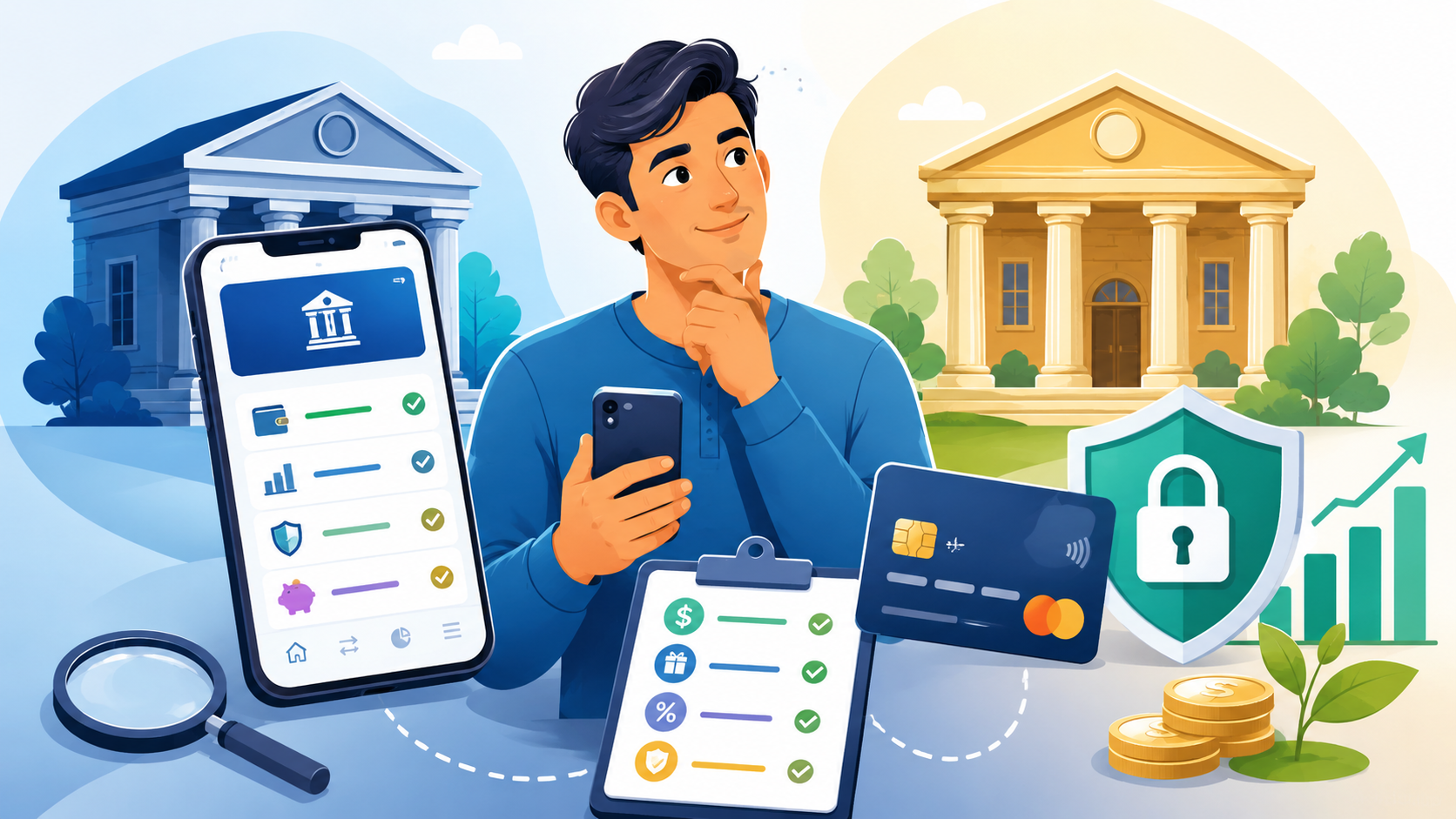
How to Choose the Best Bank: A Beginner’s Guide to Fees, Features and Security
Finance Guide
Choosing the best bank is not just about picking the most popular name. The right bank should make it easy to manage your money, avoid unnecessary fees, protect your funds, access helpful features and support your financial goals.
Your bank is one of the most important parts of your financial life. It is where your income arrives, your bills get paid, your savings may begin and your everyday spending habits become easier to track.
But not every bank is right for every person. Some banks are better for mobile banking, some are better for branch access, some offer better savings rates, and others may have lower fees or stronger customer service.
This guide explains how to choose the best bank for your needs, what features to compare, which fees to watch out for and the common mistakes beginners should avoid.
What you will learn
- What makes a bank good
- How to compare banks properly
- Which fees and charges to check
- Why mobile banking features matter
- How deposit protection works
- Why customer service is important
- How to compare savings rates and overdrafts
- Common mistakes to avoid when choosing a bank
Important:
This article is for educational purposes only. It is not personal financial advice. Banking rules, fees, protection limits and account features vary by country, so always check your local banking regulator and the bank’s current terms before opening an account.
Useful official resources
Helpful outbound links:
Consumer Financial Protection Bureau: Bank Accounts
FDIC: Deposit Insurance
FCA: Banking Information
MoneyHelper: Banking Guidance
Related guides on The Trading Journal
Helpful internal links:
How to Budget Money
How to Build an Emergency Fund
How Interest Rates Affect Your Money
How to Build Credit as a Young Adult
What Is Net Worth?
What does it mean to choose the best bank?
Choosing the best bank means finding a bank that matches how you use money. The best bank for one person may not be the best bank for someone else.
For example, someone who travels often may care about international card fees and ATM access. Someone who gets paid weekly may care more about budgeting tools. Someone saving for a house may care more about savings rates and account features.
Simple meaning:
The best bank is not always the biggest bank. It is the bank that gives you the right mix of low fees, useful features, safety, convenience and support.
Bank vs bank account: what is the difference?
A bank is the financial provider. A bank account is the product you open with that provider. This matters because a bank may offer several different account types.
You may choose a bank because you trust the provider, like the app, want branch access or prefer its customer service. You may choose a specific account because it has low fees, good savings features or useful spending tools.
Bank:
The company or financial institution that holds and manages your money.
Bank account:
The specific product you use for spending, saving, receiving income and paying bills.
1. Check the fees first
Fees are one of the most important things to compare. A bank may look attractive because of a bonus, nice app or popular brand, but regular fees can slowly reduce your money.
Common fees can include monthly account fees, overdraft charges, ATM fees, international transaction fees, transfer fees and replacement card fees.
- Monthly maintenance fees
- Overdraft fees or interest
- ATM withdrawal fees
- Foreign transaction fees
- Minimum balance fees
- Card replacement fees
- Bank transfer or wire fees
- Account closure fees
Beginner warning:
Do not choose a bank only because it offers a sign-up bonus. A bank with high ongoing fees can cost more than the bonus is worth.
2. Look at the mobile banking app
For many people, the banking app is now more important than the branch. A good app can help you check your balance, freeze your card, track spending, move money, set savings goals and manage bills.
A weak app can make everyday money management frustrating. Before choosing a bank, look at app reviews, screenshots and the features offered.
Useful app features:
Instant spending notifications.
Card freeze and unfreeze.
Budgeting categories.
Savings pots or goals.
Easy transfers.
Bill tracking.
Secure login.
Clear transaction history.
3. Check deposit protection
Deposit protection helps protect eligible money if a bank fails. The exact protection scheme and limit depend on your country.
For example, the United States has FDIC deposit insurance for eligible banks. The UK has FSCS protection for eligible firms. Other countries have their own schemes and limits.
Important:
Before opening an account, check whether the bank is covered by your country’s official deposit protection scheme and understand the protection limit.
4. Compare customer service
Customer service matters most when something goes wrong. A bank may seem fine until your card is blocked, a payment fails, your account is frozen or you need help urgently.
Compare how support works. Some banks offer phone support, live chat, branch support or 24/7 help. Others may be slower or rely heavily on automated chatbots.
Think about it:
If your card stopped working while travelling or your account was locked before rent was due, how quickly could you speak to a real person?
5. Think about branch and ATM access
Some people are comfortable with online-only banking. Others still want access to a branch for cash deposits, face-to-face help or more complex issues.
ATM access also matters. If you regularly withdraw cash, check whether the bank offers free withdrawals, a large ATM network or refunds for certain ATM fees.
Online bank:
Often strong apps, lower fees and modern features, but limited branch access.
Traditional bank:
May offer branches and wider services, but sometimes has more fees or older technology.
6. Check savings rates
If you plan to keep savings with the same bank, compare the interest rates on savings accounts. A bank may have a good current account but poor savings rates.
Savings rates can change, so do not assume your bank always offers the best deal. It is common for people to use one bank for spending and another provider for better savings rates.
Example:
You might use one bank for your wages and bills, but keep your emergency fund in a separate savings account that pays a better rate.
7. Understand overdrafts and borrowing
An overdraft lets you spend more money than you have in your account, usually up to an agreed limit. This can be useful in emergencies, but it can also become expensive and easy to rely on.
Before choosing a bank, check how overdrafts work, what they cost and whether the bank offers alerts before you go overdrawn.
Important:
An overdraft is debt. Do not treat it as extra income. If you regularly live in your overdraft, it may be a sign that your budget needs fixing.
8. Look at security features
Security should be a major part of choosing a bank. A good bank should offer strong login protection, fraud monitoring, payment alerts and easy ways to freeze your card.
You should also protect yourself by using strong passwords, enabling two-factor authentication where available and avoiding suspicious messages or links.
Security checklist:
Strong app login.
Two-factor authentication.
Instant card freeze.
Payment alerts.
Fraud monitoring.
Clear dispute process.
Secure password habits.
Never sharing PINs or one-time codes.
9. Consider international use
If you travel, shop online from international stores or send money abroad, check the bank’s international fees.
Some banks charge foreign transaction fees, poor exchange rates or ATM withdrawal fees abroad. Other banks are designed to be cheaper for travel and international payments.
Beginner tip:
If you travel often, international card fees can matter more than a small sign-up bonus.
10. Check budgeting and money management tools
A bank that helps you manage money can be more useful than a bank that only stores money. Some banks offer spending categories, savings pots, round-ups, bill reminders and monthly summaries.
These features can help beginners see where money is going and build better habits.
Example:
If your banking app shows that you spent a lot on takeaways, subscriptions or transport, it becomes easier to adjust your budget before money runs out.
11. Think about your financial goals
The best bank should fit your current life and your future goals. A student, young worker, parent, business owner, frequent traveller and serious saver may all need different features.
- For everyday spending: look for low fees and a strong app
- For saving: compare interest rates and savings tools
- For travel: check foreign transaction fees
- For cash use: check ATM and branch access
- For budgeting: look for spending insights and savings pots
- For support: compare customer service options
- For safety: check deposit protection and security features
Should you use one bank or multiple banks?
You do not have to use only one bank. Many people use one bank for everyday spending, another for savings and sometimes another for investing or business.
Using multiple banks can help you separate money, but it can also become harder to manage if you open too many accounts without a system.
One bank:
Simpler to manage and easier to track.
Multiple banks:
Can help separate spending, savings and goals, but requires better organisation.
Online banks vs traditional banks
Online banks and traditional banks both have advantages. Online banks may offer modern apps, lower fees and faster features. Traditional banks may offer branches, wider services and longer track records.
The better choice depends on how you bank. If you rarely use cash and prefer app-based money management, an online bank may suit you. If you prefer in-person support, a traditional bank may be better.
Is a switching bonus worth it?
Some banks offer cash bonuses or rewards for switching. These can be useful, but they should not be the only reason you choose a bank.
Check the conditions carefully. You may need to deposit a certain amount, set up Direct Debits, keep the account open or meet other rules.
Common mistake:
Do not switch to a worse bank just for a one-time bonus. A good bank should still be useful after the bonus is gone.
Questions to ask before choosing a bank
- Does the bank charge monthly fees?
- Are ATM withdrawals free?
- Are international card payments expensive?
- Is the mobile app reliable?
- Can I freeze my card instantly?
- Is my money protected by an official deposit protection scheme?
- How easy is it to contact customer support?
- Does the bank offer useful savings features?
- Are overdraft costs clear?
- Does this bank fit how I actually use money?
Common mistakes when choosing a bank
- Choosing a bank only because of a sign-up bonus
- Ignoring monthly fees
- Not checking overdraft charges
- Assuming all banks have the same protection
- Ignoring poor customer service reviews
- Choosing a bank with a weak app when you rely on mobile banking
- Not checking international fees before travelling
- Keeping large savings in an account with a poor interest rate
- Opening too many accounts without a plan
- Not reading the account terms
Best bank checklist for beginners
Before choosing a bank, check:
Low or no monthly fees.
Clear overdraft costs.
Reliable mobile app.
Strong security features.
Good customer support.
Deposit protection.
Easy access to your money.
Useful savings options.
Fair international fees.
Features that match your lifestyle.
Frequently asked questions
What is the most important thing when choosing a bank?
The most important thing is whether the bank fits how you use money. Fees, security, app features, customer service and deposit protection are all important.
Is an online bank better than a traditional bank?
Not always. Online banks can be great for apps and low fees, while traditional banks may be better for branch access and in-person help.
Should I choose the bank with the highest savings rate?
A high savings rate is useful, but it is only one factor. You should also consider access, protection, fees and whether the account suits your goals.
Are switching bonuses worth it?
They can be worth it if the bank is still good after the bonus. Do not choose a poor account just for a short-term reward.
Can I have more than one bank?
Yes. Many people use multiple banks for spending, savings and bills. Just make sure you can manage them properly.
Quick recap
- The best bank depends on your lifestyle and goals
- Check fees before opening an account
- A good mobile app can make money management easier
- Deposit protection varies by country
- Customer service matters when problems happen
- Savings rates and overdraft costs should be compared
- Security features are essential
- Do not choose a bank only because of a sign-up bonus
Final thoughts
Choosing the best bank is not about finding the bank everyone else uses. It is about finding the bank that makes your financial life easier, safer and more organised.
A good bank should help you manage money confidently. It should have clear fees, strong security, helpful features and support that you can rely on when something goes wrong.
The best bank is the one that fits your real life: how you spend, save, travel, budget, access support and protect your money.