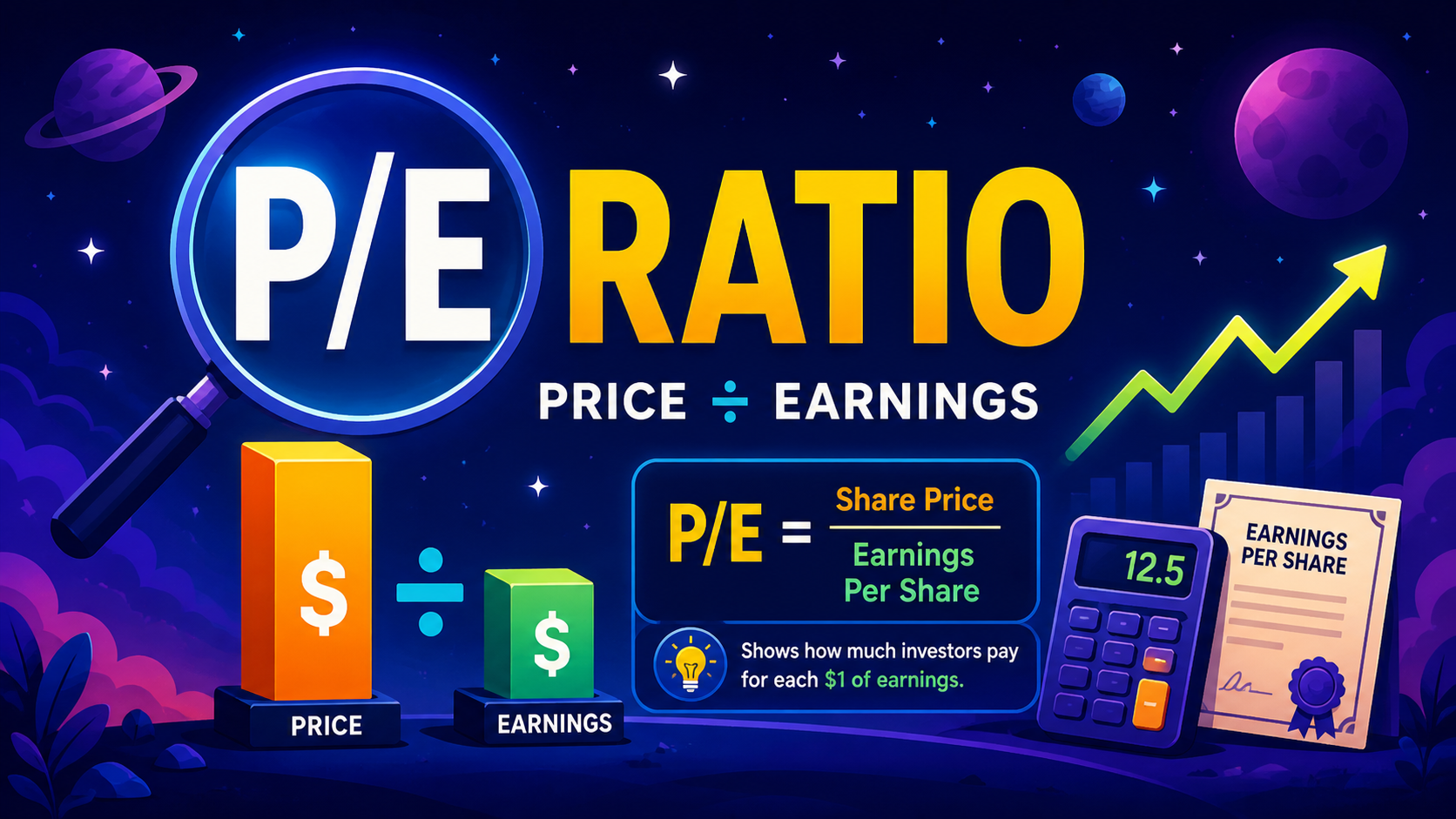
What Is the P/E Ratio? A Beginner’s Guide to Valuing Stocks
Stock Guide
The P/E ratio, or price-to-earnings ratio, is one of the most common ways investors compare a company’s share price with its earnings.
When beginners start learning about stocks, they often focus only on whether a share price is going up or down. But a stock price by itself does not tell you whether a company is cheap, expensive, fairly valued, or risky.
That is where the P/E ratio can help. It gives investors a simple way to compare the price of a stock with the profits the company is earning.
A P/E ratio is not perfect, and it should never be used on its own. But it is one of the most useful first concepts for anyone learning how to analyse stocks.
What you will learn
- What the P/E ratio means
- How to calculate the P/E ratio
- What a high P/E ratio can mean
- What a low P/E ratio can mean
- Why P/E ratios differ between industries
- The difference between trailing P/E and forward P/E
- The limitations of the P/E ratio
- How beginners can use it without making common mistakes
Important:
This article is for educational purposes only. It is not personal financial advice. Stocks can fall as well as rise, and valuation ratios should be used as part of wider research.
Useful official resources
Helpful outbound links:
Investor.gov: Price-earnings P/E ratio
FINRA: Evaluating stocks
FINRA: Financial performance metrics investors should know
Investor.gov: Stocks
Related guides on The Trading Journal
Helpful internal links:
How to Start Investing for Beginners
What Are Dividend Stocks?
What Is Dollar-Cost Averaging?
How Interest Rates Affect the Stock Market
What Is Net Worth?
What is the P/E ratio?
The P/E ratio stands for price-to-earnings ratio. It compares a company’s share price with its earnings per share.
In simple terms, it shows how much investors are willing to pay for each unit of company profit.
P/E ratio formula:
Share Price ÷ Earnings Per Share = P/E Ratio
For example, if a company’s share price is £50 and its earnings per share are £5, the P/E ratio is 10.
Simple meaning:
A P/E ratio of 10 means investors are paying £10 for every £1 of annual earnings per share.
What is earnings per share?
Earnings per share, often called EPS, shows how much profit is assigned to each share of a company.
It is calculated by taking the company’s earnings and dividing them by the number of shares outstanding. Investors use EPS because it helps connect company profit to individual shares.
You do not always need to calculate EPS yourself because many finance websites and company reports show it. But understanding what it means helps you understand the P/E ratio properly.
A simple P/E ratio example
Imagine two companies both earn money, but their share prices and earnings are different.
- Company A share price: £100
- Company A earnings per share: £5
- Company A P/E ratio: 20
- Company B share price: £60
- Company B earnings per share: £5
- Company B P/E ratio: 12
Both companies earn £5 per share, but investors are paying much more for Company A’s earnings than Company B’s earnings.
That does not automatically mean Company A is bad or Company B is good. It simply means the market is valuing their earnings differently.
What does a high P/E ratio mean?
A high P/E ratio often means investors expect strong future growth. They may be willing to pay more today because they believe the company’s profits will grow significantly in the future.
This is common with growth stocks, especially companies in technology, healthcare innovation, or fast-growing industries.
- Investors may expect fast earnings growth
- The company may be popular or highly trusted
- The stock may be expensive compared with current earnings
- The company may need strong future results to justify the price
Important:
A high P/E ratio is not automatically bad, but it can become risky if future growth does not meet expectations.
What does a low P/E ratio mean?
A low P/E ratio may mean a stock is cheaper compared with its earnings. But it can also mean investors are worried about the company’s future.
This is why a low P/E ratio should not automatically be treated as a bargain. Sometimes the market is pricing in real problems.
- The stock may be undervalued
- The company may be out of favour
- Investors may expect earnings to fall
- The business may be facing serious risks
- The industry may be under pressure
Beginner tip:
A low P/E ratio can be an opportunity, but it can also be a warning sign. Always ask why the ratio is low.
What is a good P/E ratio?
There is no single perfect P/E ratio. A good P/E ratio depends on the company, industry, growth rate, profit quality, interest rates, and market conditions.
A P/E ratio that looks high for one industry may be normal for another. For example, a fast-growing software company may trade at a higher P/E than a mature utility company.
The smarter question is not “Is this P/E ratio high or low?” It is “Is this P/E ratio reasonable for this company’s growth, quality, and risk?”
Why P/E ratios differ by industry
Different industries have different growth rates, profit margins, risks, and investor expectations. That is why comparing P/E ratios across unrelated sectors can be misleading.
A bank, supermarket, software company, oil producer, and electric vehicle company may all have very different P/E ratios because investors expect different things from them.
- Fast-growth industries often have higher P/E ratios
- Mature industries often have lower P/E ratios
- Cyclical companies may have misleading P/E ratios
- Highly stable companies may be valued differently from risky companies
- Interest rates can affect how much investors are willing to pay for future earnings
Trailing P/E vs forward P/E
There are two common types of P/E ratio: trailing P/E and forward P/E.
Trailing P/E:
Uses earnings from the past, usually the last 12 months.
Forward P/E:
Uses expected future earnings, usually based on analyst estimates or company forecasts.
Trailing P/E is based on real past numbers, but it may not show where the company is going. Forward P/E tries to look ahead, but it depends on forecasts, which can be wrong.
Why the P/E ratio can be useful
The P/E ratio is useful because it gives investors a quick way to compare stock prices with earnings.
- It helps compare companies in the same industry
- It can show whether a stock looks expensive or cheap compared with its history
- It helps investors think about expectations
- It is simple enough for beginners to understand
- It can be a starting point for deeper research
The key phrase is starting point. The P/E ratio can help you ask better questions, but it does not answer everything.
The limitations of the P/E ratio
The P/E ratio has limits. It only works properly when a company has earnings. If a company is losing money, the P/E ratio may not be useful.
It can also be distorted by one-off profits, accounting changes, cyclical earnings, debt levels, and temporary business conditions.
- It does not show debt levels
- It does not show cash flow quality
- It can be misleading for cyclical companies
- It may not work for unprofitable companies
- It does not tell you whether earnings will grow
- It should not be used without other research
P/E ratio and growth stocks
Growth stocks often have higher P/E ratios because investors expect profits to grow quickly in the future.
This can make sense if the company actually delivers strong growth. But if growth slows, the share price can fall sharply because investors may no longer want to pay a premium.
Example:
A company with a high P/E ratio may need years of strong profit growth to justify its valuation. If that growth disappoints, the stock can become vulnerable.
P/E ratio and value stocks
Value stocks often have lower P/E ratios. Investors may believe these companies are undervalued, overlooked, or priced too cheaply compared with their earnings.
But a low P/E ratio can also happen because the business is weakening. This is why value investing requires research, not just buying the cheapest-looking stock.
Common trap:
A cheap stock can always become cheaper if the business keeps getting worse.
P/E ratio and interest rates
Interest rates can affect P/E ratios because they influence how investors value future earnings.
When interest rates are low, investors may be willing to pay higher prices for future growth. When interest rates are high, investors may become more cautious and demand lower valuations.
This is one reason growth stocks can be sensitive to rate changes. If rates rise, high P/E stocks can come under pressure.
How beginners should use the P/E ratio
Beginners should use the P/E ratio as a simple screening tool, not as a final decision-maker.
A good way to use it is to compare a company with similar companies in the same industry, then ask why the ratio is higher or lower.
- Compare companies in the same sector
- Compare the stock with its own historical P/E ratio
- Ask whether earnings are growing or shrinking
- Check whether debt is high
- Look at cash flow, not just earnings
- Read recent company results
- Avoid buying only because the P/E ratio looks low
Common P/E ratio mistakes
- Thinking a low P/E always means cheap
- Thinking a high P/E always means bad
- Comparing companies from completely different industries
- Ignoring growth rates
- Ignoring debt and cash flow
- Using forward P/E without understanding forecast risk
- Buying a stock based on one ratio only
Beginner reminder:
The P/E ratio is useful, but no single number can tell you whether a stock is a good investment.
P/E ratio checklist
Before using the P/E ratio to judge a stock, ask these questions.
- Is the company profitable?
- Is the P/E ratio based on past or future earnings?
- How does it compare with similar companies?
- Is the company growing or slowing down?
- Is the stock cheap for a reason?
- Does the company have too much debt?
- Are earnings reliable or distorted by one-off events?
- Does the stock fit my wider investment plan?
Frequently asked questions
Is a low P/E ratio good?
Not always. A low P/E ratio can mean a stock is undervalued, but it can also mean investors expect the company to struggle.
Is a high P/E ratio bad?
Not always. A high P/E ratio can mean investors expect strong growth. But it can become risky if the company fails to meet expectations.
What is the P/E ratio formula?
The formula is share price divided by earnings per share.
Can a company have no P/E ratio?
Yes. If a company has no earnings or is losing money, the P/E ratio may not be useful or may not be shown.
Should beginners use the P/E ratio?
Yes, but only as one part of research. It is useful for understanding valuation, but it should be combined with business quality, growth, debt, cash flow, and risk.
Quick recap
- P/E ratio means price-to-earnings ratio
- It compares a company’s share price with its earnings per share
- A high P/E can signal growth expectations or overvaluation
- A low P/E can signal value or business risk
- P/E ratios should usually be compared within the same industry
- Trailing P/E uses past earnings, while forward P/E uses expected future earnings
- The P/E ratio is useful, but it should not be used alone
Final thoughts
The P/E ratio is one of the first stock valuation tools beginners should understand because it connects a company’s share price to its earnings.
It can help you think more clearly about whether a stock looks expensive, cheap, or fairly valued compared with similar companies. But it is not a magic answer.
The best way to use the P/E ratio is as a starting point: understand what the market is pricing in, then look deeper at the company’s growth, risk, debt, cash flow, and long-term business quality.