What Is Dollar-Cost Averaging? A Beginner’s Guide to Investing Consistently
Investing Guide
Dollar-cost averaging is an investing strategy where you invest a fixed amount of money at regular intervals instead of trying to perfectly time the market.
For beginners, one of the hardest parts of investing is deciding when to start. Markets move up and down, news headlines create fear, and many people wait for the perfect moment that never clearly arrives.
Dollar-cost averaging helps solve this problem by turning investing into a simple habit. Instead of trying to guess the best day to invest, you invest consistently over time.
In the UK, the same idea is often called pound-cost averaging. The name is different, but the principle is the same: invest the same amount regularly, whether prices are high or low.
What you will learn
- What dollar-cost averaging means
- How dollar-cost averaging works
- Why beginners use it
- A simple example using monthly investing
- The benefits of investing regularly
- The disadvantages and risks
- Dollar-cost averaging vs lump-sum investing
- Common mistakes to avoid
Important:
This article is for educational purposes only. It is not personal financial advice. Investments can go down as well as up, and you should only invest money that matches your own financial situation, goals, and risk tolerance.
Useful official resources
Helpful outbound links:
Investor.gov: Dollar-cost averaging
Investor.gov: Compound interest calculator
FCA: Should you invest?
FCA: 5 smart investment checks
Related guides on The Trading Journal
Helpful internal links:
How to Start Investing for Beginners
What Is a Money Market Account?
What Is Net Worth?
How Interest Rates Affect the Stock Market
The Beginner's Guide To Personal Finance
What is dollar-cost averaging?
Dollar-cost averaging is an investment strategy where you invest the same amount of money at regular intervals, no matter what the market is doing.
For example, instead of investing £1,200 all at once, you might invest £100 every month for 12 months. Some months the market may be higher. Some months it may be lower. The point is that you keep investing according to your plan.
Simple formula:
Fixed amount + regular schedule + long-term mindset = dollar-cost averaging
This strategy is popular with beginners because it removes some of the pressure of trying to predict short-term market movements.
Why is it called dollar-cost averaging?
The phrase comes from the idea that your average purchase price may smooth out over time.
When prices are high, your fixed investment buys fewer units. When prices are low, the same amount of money buys more units. Over time, this can create an average buying price across different market conditions.
In the UK, you may also hear people call it pound-cost averaging. Both terms describe the same basic idea.
A simple dollar-cost averaging example
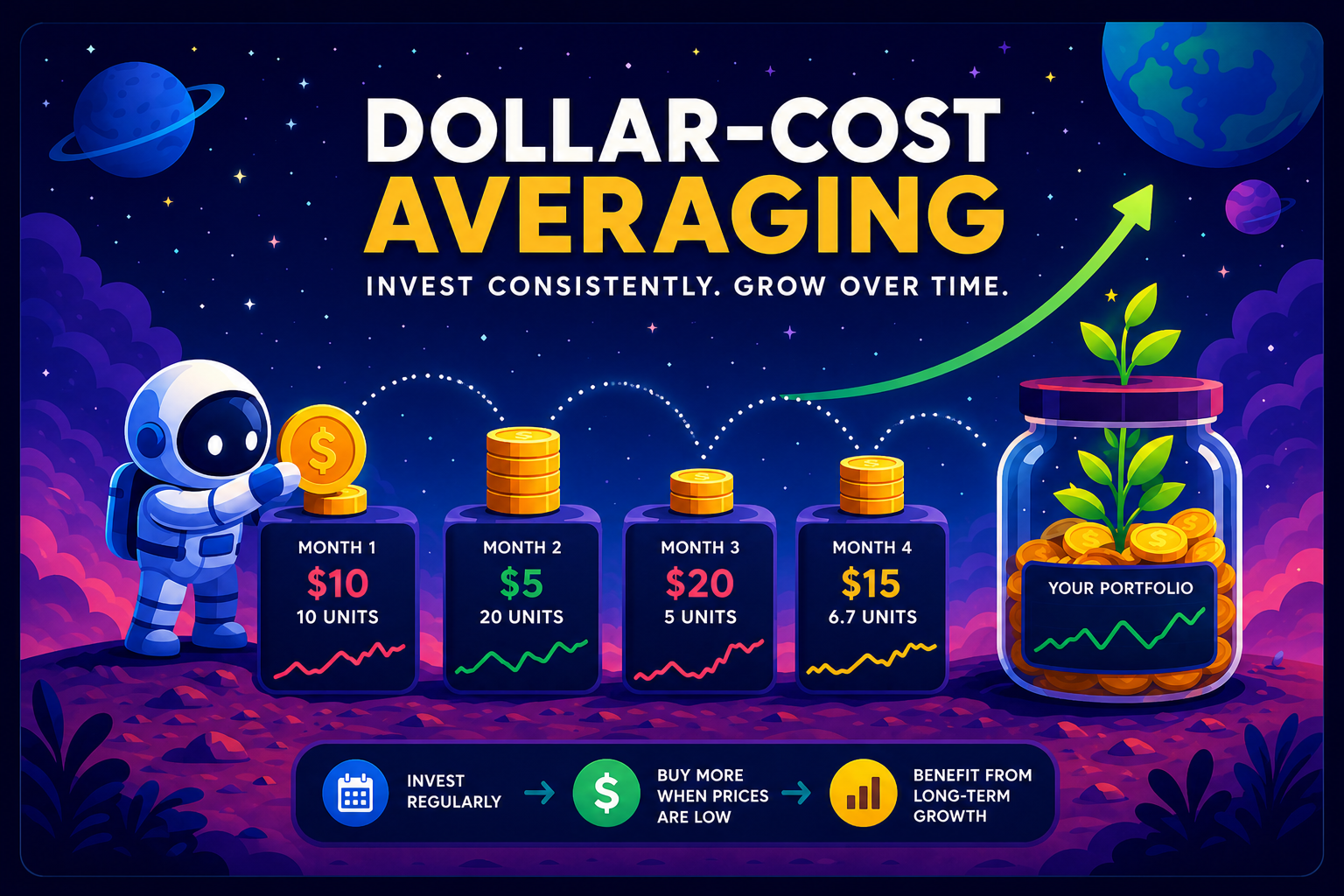
Imagine you decide to invest £100 every month into a fund.
- Month 1: the fund costs £10 per unit, so £100 buys 10 units
- Month 2: the fund falls to £5 per unit, so £100 buys 20 units
- Month 3: the fund rises to £20 per unit, so £100 buys 5 units
You invested the same amount each month, but you bought different numbers of units depending on the price.
Key point:
You did not need to guess the perfect moment. You simply followed a regular investing plan.
Why beginners like dollar-cost averaging
Beginners often struggle with fear and timing. They worry about investing just before the market drops, so they delay starting. Dollar-cost averaging can make investing feel more manageable because you are not putting all your money in at once.
- It makes investing feel less intimidating
- It helps build a regular habit
- It reduces the pressure of market timing
- It can make market falls feel less frightening
- It works well with monthly income
- It keeps your plan simple and repeatable
For many beginners, the biggest benefit is psychological. A plan you can actually stick to is often more useful than a complicated strategy you abandon after one bad month.
Dollar-cost averaging and market volatility
Market volatility means prices move up and down. For new investors, this can feel uncomfortable. A sudden drop can make people panic, while a sudden rise can make people rush in too late.
Dollar-cost averaging does not remove volatility, but it can help you deal with it more calmly. Because you are investing regularly, lower prices are not automatically bad. They can mean your fixed contribution buys more units.
Think about it:
If you are investing for the long term, would you rather panic every time prices fall, or have a plan that continues through different market conditions?
Dollar-cost averaging vs trying to time the market
Trying to time the market means attempting to buy at the bottom and sell at the top. It sounds attractive, but it is extremely difficult to do consistently.
Many beginners wait for the perfect entry point, but markets rarely make things obvious. By the time people feel confident, prices may have already moved.
Dollar-cost averaging shifts the focus from prediction to consistency.
Instead of asking, “Is today the perfect time to invest?” you ask, “Can I keep investing responsibly over the long term?”
Dollar-cost averaging vs lump-sum investing
Lump-sum investing means investing a larger amount of money all at once. Dollar-cost averaging means spreading the investment over time.
Lump-sum investing:
You invest a larger amount immediately. This gives your money more time in the market, but it can feel risky if prices fall shortly after.
Dollar-cost averaging:
You invest smaller amounts gradually. This can feel more comfortable, but some money may stay in cash while waiting to be invested.
Neither approach is perfect for everyone. The better choice depends on your confidence, risk tolerance, time horizon, and financial situation.
The main benefits of dollar-cost averaging
Dollar-cost averaging is not popular because it guarantees the best return. It is popular because it makes investing easier to start and easier to repeat.
- It helps reduce emotional decision-making
- It creates a consistent investing habit
- It works naturally with monthly wages
- It can reduce regret if markets fall after you start
- It avoids relying on perfect timing
- It can help beginners stay invested during uncertain periods
Beginner tip:
The biggest advantage is often discipline. Regular investing helps you focus on the long-term plan instead of daily market noise.
The disadvantages of dollar-cost averaging
Dollar-cost averaging also has disadvantages. It is not automatically the highest-return strategy in every situation.
- It does not guarantee profit
- It does not protect you from losses
- It may underperform lump-sum investing in rising markets
- It can still lead to poor results if you invest in bad assets
- It may create false confidence if you ignore risk
- You still need to understand what you are investing in
Important:
Investing regularly into a poor investment does not make it a good investment. Dollar-cost averaging is a method of investing, not a replacement for research.
Does dollar-cost averaging reduce risk?
Dollar-cost averaging can reduce timing risk because you are not investing everything on one single day. If the market drops shortly after your first contribution, only part of your planned investment is affected.
However, it does not remove investment risk. If the asset you are buying falls for a long time or never recovers, you can still lose money.
This is why diversification matters. Many beginners use dollar-cost averaging with diversified funds instead of putting all their money into one company.
What investments can you use it with?
Dollar-cost averaging can be used with different types of investments, but beginners often use it with diversified funds because they spread money across many assets.
- Index funds
- Exchange-traded funds
- Mutual funds
- Investment trusts
- Pension contributions
- Stocks and shares ISA investments
- Regular brokerage account investments
The key is not just investing regularly. The key is investing regularly into something you understand and that matches your goals.
Why it works well with long-term investing
Dollar-cost averaging fits long-term investing because it rewards consistency. You are not trying to win quickly. You are trying to build wealth gradually through regular contributions and time in the market.
This is especially useful for people who invest from their monthly income. Instead of needing a large starting amount, they can build a portfolio step by step.
For many ordinary investors, the habit of investing every month matters more than finding the perfect moment to begin.
Dollar-cost averaging and compound growth
Regular investing can become more powerful when combined with compound growth. Compound growth is when your returns begin to generate returns of their own.
The earlier you start and the longer you stay consistent, the more time your money has to potentially grow.
Simple example:
If you invest every month for many years, your portfolio is built from both your contributions and any growth those investments produce over time.
How much should you invest regularly?
There is no perfect amount for everyone. The right amount depends on your income, expenses, debts, emergency fund, and goals.
A beginner should not invest money needed for rent, food, bills, debt repayments, or emergencies. Investing should support your financial life, not make it more stressful.
- Start with an amount you can afford
- Make sure your bills are covered first
- Build an emergency fund before taking too much risk
- Avoid investing money you need soon
- Increase contributions gradually if your income improves
A realistic beginner example
Imagine someone earns a monthly salary and decides to invest £50 each month into a diversified fund.
They set up an automatic investment shortly after payday. Some months the market is up. Some months the market is down. But they keep investing the same amount because their goal is long-term growth, not short-term trading.
Why this helps:
The investor does not need to check prices every day. The habit is automated, simple, and easier to maintain.
Should you automate it?
Automation can make dollar-cost averaging easier. If you manually decide every month, emotions can get in the way. You may delay investing because the market looks scary or because headlines sound negative.
An automatic monthly contribution helps remove that hesitation. It turns investing into part of your routine.
Simple habit:
Many people choose to invest shortly after payday so the money is invested before it gets spent elsewhere.
Who may benefit from dollar-cost averaging?
Dollar-cost averaging may suit people who want a simple, steady approach to investing.
- Beginners who feel nervous about investing
- People investing from monthly income
- Long-term investors building wealth gradually
- People who do not want to time the market
- Investors who prefer automation and routine
- People who want to reduce emotional decision-making
Who should be careful?
Dollar-cost averaging may not be suitable for everyone. It should not be used as an excuse to invest before your finances are ready.
- People with high-interest debt they need to deal with first
- People without any emergency savings
- People investing money they may need soon
- People buying assets they do not understand
- People expecting guaranteed returns
- People using regular investing to chase hype
Common mistake:
Investing regularly does not mean investing blindly. You still need to understand the risk, fees, and purpose of the investment.
Common dollar-cost averaging mistakes
- Starting before building a basic emergency fund
- Investing money needed in the short term
- Choosing investments based on social media hype
- Stopping the plan every time the market falls
- Ignoring fees
- Using the strategy without understanding risk
- Changing the plan too often
- Expecting smooth returns every month
The biggest mistake is treating dollar-cost averaging as a guarantee. It is not a guarantee. It is a disciplined way to invest over time.
Dollar-cost averaging checklist
Before using this strategy, ask yourself these questions.
- Can I afford to invest this amount regularly?
- Do I have emergency savings?
- Have I dealt with expensive short-term debt?
- Do I understand what I am investing in?
- Am I investing for years, not weeks?
- Have I checked the fees?
- Can I stay calm if the market falls?
- Does this investment match my goals?
Frequently asked questions
Is dollar-cost averaging good for beginners?
It can be useful for beginners because it creates a simple investing habit and reduces the pressure of timing the market. However, beginners still need to understand risk and only invest money they can afford to leave invested.
Can you lose money with dollar-cost averaging?
Yes. Dollar-cost averaging does not remove investment risk. If the investment falls in value, you can still lose money.
Is dollar-cost averaging better than lump-sum investing?
Not always. Lump-sum investing may do better in rising markets because more money is invested earlier. Dollar-cost averaging may feel more comfortable for people who are worried about investing all at once.
How often should you invest?
Many people invest monthly because it matches their income cycle. Others may invest weekly or quarterly. The best schedule is one you can afford and maintain consistently.
Is pound-cost averaging the same thing?
Yes. Pound-cost averaging is the UK wording for the same idea. It means investing a fixed amount regularly over time.
Quick recap
- Dollar-cost averaging means investing a fixed amount regularly
- It helps reduce the pressure of timing the market
- It works well for people investing from monthly income
- It can make investing feel more manageable for beginners
- It does not guarantee profits or remove risk
- It should be used with investments you understand
- The strategy works best with patience and long-term consistency
Final thoughts
Dollar-cost averaging is one of the simplest investing strategies for beginners because it focuses on consistency instead of prediction.
It does not promise perfect results. It does not protect you from every market fall. But it can help you build a repeatable investing habit and avoid waiting forever for the perfect time to start.
For long-term investors, the most powerful part of dollar-cost averaging is not the formula. It is the discipline of investing steadily, patiently, and responsibly over time.