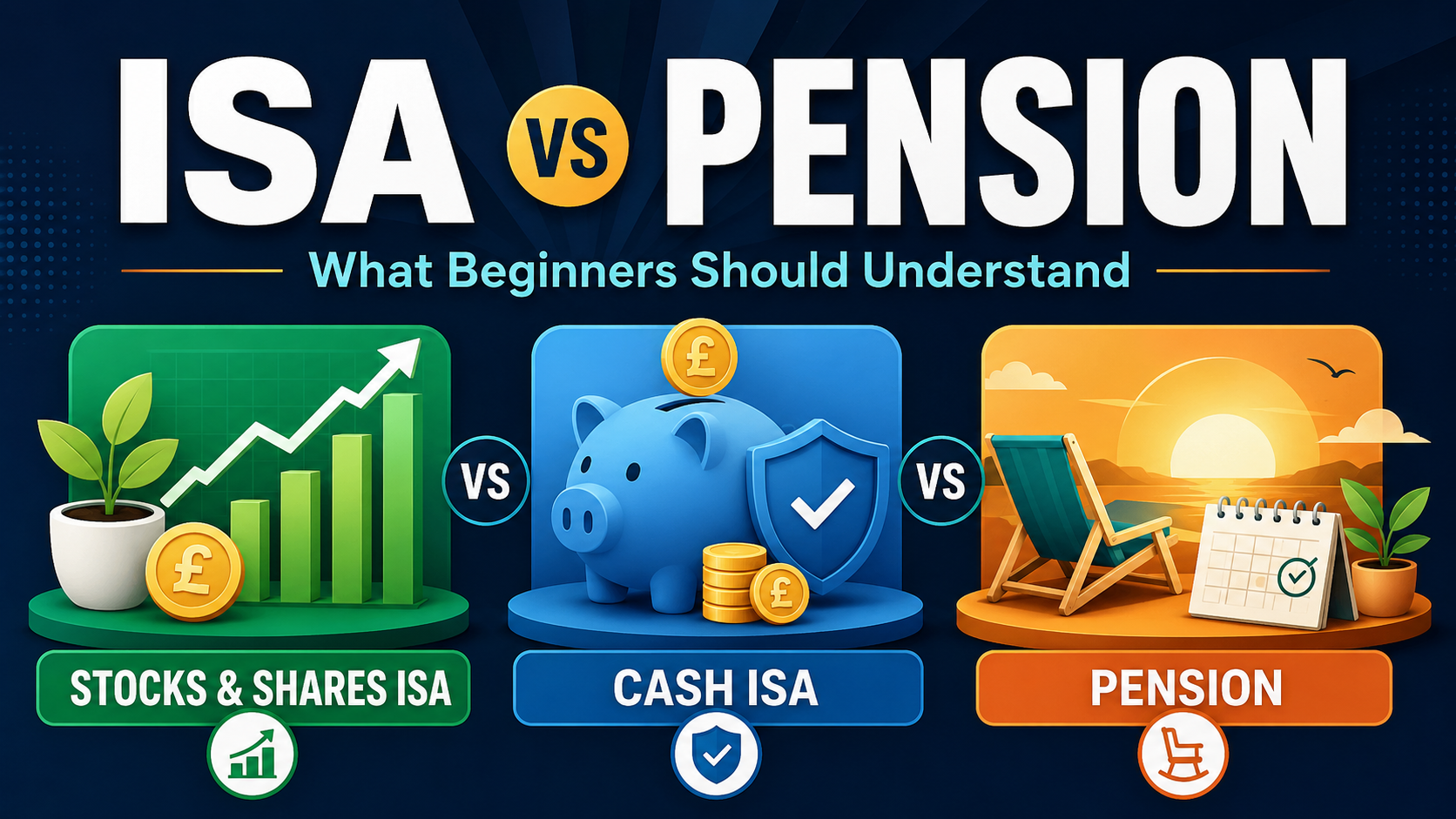
Stocks and Shares ISA vs Cash ISA vs Pension: What Beginners Should Understand
Investing Guide
A Stocks and Shares ISA, Cash ISA and pension can all help you save or invest more tax-efficiently, but they are designed for different goals. The right choice depends on when you need the money, how much risk you can handle and whether you are saving for short-term security or long-term wealth.
Many beginners know they should save or invest, but they get stuck choosing the right account. A Cash ISA feels safe, a Stocks and Shares ISA offers investment growth potential, and a pension is designed for retirement.
The problem is that these accounts are often talked about as if one is automatically better than the others. In reality, they are different tools. A Cash ISA can be useful for short-term savings. A Stocks and Shares ISA can be useful for long-term investing. A pension can be powerful for retirement planning.
This guide explains the difference between a Stocks and Shares ISA, Cash ISA and pension in simple language so you can understand what each one is for before deciding what fits your own financial goals.
What you will learn
- What a Cash ISA is
- What a Stocks and Shares ISA is
- What a pension is
- The main differences between them
- Which account may suit short-term goals
- Which account may suit long-term investing
- How risk and access rules differ
- Why pensions can be powerful for retirement
- Common beginner mistakes to avoid
Important:
This article is for educational purposes only. It is not personal financial advice. ISA and pension rules, tax treatment, allowances and access rules can change. Always check the current rules or speak to a qualified financial adviser if you are unsure.
Useful official resources
Helpful outbound links:
GOV.UK: Individual Savings Accounts
MoneyHelper: ISAs and tax-efficient saving
MoneyHelper: Stocks and Shares ISAs
MoneyHelper: Cash ISAs
GOV.UK: Pension tax relief
Related guides on The Trading Journal
Helpful internal links:
How to Start Investing for Beginners
What Is Dollar-Cost Averaging?
What Is an Index Fund?
What Is Compound Interest?
How Interest Rates Affect Your Money
What is a Cash ISA?
A Cash ISA is a tax-efficient savings account. You put cash into the account and earn interest. The main benefit is that interest earned inside a Cash ISA is not taxed.
Cash ISAs are usually used for saving rather than investing. They may be useful for emergency funds, short-term goals, house deposits or money you do not want exposed to stock market risk.
Simple meaning:
A Cash ISA is mainly for saving cash tax-efficiently. It is not designed to grow like an investment account, but it can be useful for safety and short-term goals.
What is a Stocks and Shares ISA?
A Stocks and Shares ISA is a tax-efficient investment account. Instead of only holding cash, you can invest in things like funds, ETFs, investment trusts, bonds and individual shares, depending on the provider.
The value of a Stocks and Shares ISA can rise and fall because investments move with the market. That means it has more growth potential than cash, but also more risk.
Important:
A Stocks and Shares ISA can fall in value. It is usually more suitable for long-term goals, not money you may need very soon.
What is a pension?
A pension is a long-term account designed to help you save and invest for retirement. Pensions can receive tax benefits, and workplace pensions may include employer contributions.
The main trade-off is access. Pension money is usually locked away until later life, so it is not suitable for short-term savings or emergency money.
ISA:
Usually more flexible access, depending on the account type and provider terms.
Pension:
Designed for retirement, often with tax benefits, but access is restricted until later life.
Cash ISA vs Stocks and Shares ISA
A Cash ISA and Stocks and Shares ISA both sit under the ISA system, but they behave very differently.
Cash ISA:
Lower risk, pays interest, useful for short-term savings and emergency money.
Stocks and Shares ISA:
Higher risk, investment growth potential, useful for long-term wealth building.
The biggest question is when you need the money. If you need it soon, cash may be more suitable. If your goal is many years away, investing may give your money more chance to grow.
Stocks and Shares ISA vs pension
A Stocks and Shares ISA and pension can both be used for long-term investing, but they have different rules and purposes.
Stocks and Shares ISA:
More flexible, useful for long-term goals before retirement, and withdrawals are usually tax-free under current ISA rules.
Pension:
Designed for retirement, may include employer contributions and tax relief, but access is restricted.
For many workers, a pension is especially powerful because employer contributions can add extra money to your retirement savings. Ignoring workplace pension contributions can mean missing out on money from your employer.
Beginner tip:
If your employer offers pension matching or contributions, understand how it works before focusing only on an ISA.
Cash ISA vs pension
A Cash ISA and pension are very different. A Cash ISA is usually for accessible savings. A pension is for retirement.
If you are saving for a car, holiday, emergency fund or short-term goal, a Cash ISA may make sense. If you are saving for retirement decades away, a pension may be more suitable.
Cash ISA:
Useful for short-term savings and lower-risk money.
Pension:
Useful for long-term retirement planning, but not suitable for money you need soon.
Which one is best for beginners?
There is no single best option for everyone. The best choice depends on your goal, time horizon, risk tolerance and whether you need access to the money.
- Emergency fund: Cash savings or Cash ISA
- Short-term goal: Cash ISA or easy-access savings
- House deposit soon: Cash ISA or suitable low-risk savings
- Long-term investing: Stocks and Shares ISA
- Retirement: Pension
- Employer pension match: Workplace pension often deserves attention
- Money needed soon: Avoid stock market risk where possible
Simple example:
If you are saving for car insurance due in six months, a Stocks and Shares ISA may be too risky. If you are investing for 10 years, keeping everything in a Cash ISA may reduce your long-term growth potential.
Risk: cash vs investing
Cash is usually more stable in the short term, but inflation can reduce its buying power over time. Investments can grow more over the long term, but they can also fall sharply in the short term.
This is why the time horizon matters. Money you need soon should usually be kept safer. Money you do not need for many years may be able to handle more investment risk.
Think about it:
Is your biggest risk losing money in the short term, or is your biggest risk that inflation reduces your wealth over many years?
Access: when can you use the money?
Access is one of the biggest differences between these accounts. Cash ISAs may offer easy access or fixed terms, depending on the product. Stocks and Shares ISAs can usually be sold and withdrawn, but markets may be down when you need the money.
Pensions are usually the least flexible because they are designed for retirement. That restriction can be frustrating, but it can also protect your future money from being spent too early.
Common mistake:
Do not put emergency money into an account that is hard to access or exposed to investment volatility.
Tax benefits: why these accounts matter
ISAs and pensions are popular because they can reduce tax on savings and investments. A Cash ISA can shelter interest from tax. A Stocks and Shares ISA can shelter investment gains and income from tax. A pension can offer tax relief on contributions and is designed to support retirement saving.
However, tax rules can change, and the best choice depends on your income, age, goals and personal situation.
Simple rule:
ISAs are often about tax-efficient flexibility. Pensions are often about tax-efficient retirement planning.
A simple account order for beginners
A beginner does not need a complicated system. Start with your foundations, then build long-term wealth.
- Build a small emergency fund
- Clear expensive high-interest debt
- Use your workplace pension if employer contributions are available
- Use a Cash ISA or savings account for short-term goals
- Use a Stocks and Shares ISA for long-term investing
- Increase pension and ISA contributions gradually as your income improves
Simple rule:
Use cash for safety and short-term goals. Use investing for long-term growth. Use pensions for retirement.
When a Cash ISA may make sense
- You need the money soon
- You are building an emergency fund
- You do not want investment risk
- You are saving for a short-term goal
- You want tax-free interest
- You want simple and predictable savings
Example:
If you are saving for a house deposit you may need within one year, you may prefer lower-risk cash rather than investing in the stock market.
When a Stocks and Shares ISA may make sense
- You are investing for several years or more
- You can handle market ups and downs
- You want long-term growth potential
- You already have emergency savings
- You understand investments can fall
- You want tax-efficient investing outside a pension
Important:
A Stocks and Shares ISA is not automatically safe just because it is an ISA. The ISA is the tax wrapper. The investments inside still carry risk.
When a pension may make sense
- You are saving for retirement
- Your employer contributes to your pension
- You want long-term tax-efficient retirement saving
- You do not need access to the money soon
- You want to build wealth for later life
- You are comfortable with money being locked away
Beginner tip:
A pension can be one of the strongest long-term wealth tools, but it is not suitable for short-term money because access is restricted.
Can you use all three?
Yes. Many people use all three for different reasons. A Cash ISA can hold short-term savings, a Stocks and Shares ISA can support long-term investing, and a pension can build retirement wealth.
Using all three can make sense if each account has a clear job. Problems happen when people use the wrong account for the wrong goal.
Cash ISA:
Short-term safety.
Stocks and Shares ISA:
Long-term flexible investing.
Pension:
Retirement investing.
Common mistakes beginners make
- Investing emergency money in the stock market
- Ignoring employer pension contributions
- Keeping all long-term wealth in cash forever
- Choosing an ISA without understanding fees
- Opening accounts because of social media hype
- Forgetting that investments can fall
- Using a pension for money you may need soon
- Assuming one account is always best for everyone
- Not checking current ISA and pension rules
- Confusing the tax wrapper with the investment itself
Big mistake:
Do not choose between a Cash ISA, Stocks and Shares ISA and pension based only on which one sounds popular. Choose based on your goal and time frame.
Beginner checklist
Before choosing, ask:
When do I need the money?
Can I handle investment risk?
Do I already have an emergency fund?
Do I have expensive debt?
Does my employer contribute to my pension?
Am I saving for retirement or an earlier goal?
Have I checked the fees?
Have I checked the current tax rules?
Frequently asked questions
Is a Stocks and Shares ISA better than a Cash ISA?
Not always. A Stocks and Shares ISA may be better for long-term growth, while a Cash ISA may be better for short-term savings and emergency money.
Should I use a pension or ISA first?
It depends on your goals. If your employer offers pension contributions, your workplace pension may deserve attention. ISAs may be more flexible for goals before retirement.
Can I lose money in a Stocks and Shares ISA?
Yes. The ISA wrapper does not remove investment risk. Your investments can rise and fall in value.
Is a Cash ISA risk-free?
A Cash ISA is usually lower risk than investing, but inflation can reduce the buying power of your money over time. You should also check provider protection and account terms.
Can I have a Cash ISA and Stocks and Shares ISA?
Yes, but you must stay within the current ISA rules and annual allowance. Always check the latest rules before contributing.
Is a pension better than a Stocks and Shares ISA?
A pension can be better for retirement because of tax benefits and employer contributions, but a Stocks and Shares ISA can be more flexible for money you may want before retirement.
Quick recap
- Cash ISAs are mainly for tax-efficient saving
- Stocks and Shares ISAs are for tax-efficient investing
- Pensions are designed for retirement
- Cash is usually better for short-term goals
- Investing is usually better for long-term growth potential
- Pensions can be powerful but less flexible
- Employer pension contributions can be valuable
- The best account depends on your goal, risk tolerance and time horizon
Final thoughts
A Cash ISA, Stocks and Shares ISA and pension are not enemies. They are tools. The mistake is trying to use one tool for every job.
For beginners, the best approach is to match the account to the goal. Short-term safety, long-term growth and retirement planning each need different thinking.
The simple rule is this: use cash for money you need soon, investments for money you can leave alone for years, and pensions for retirement.