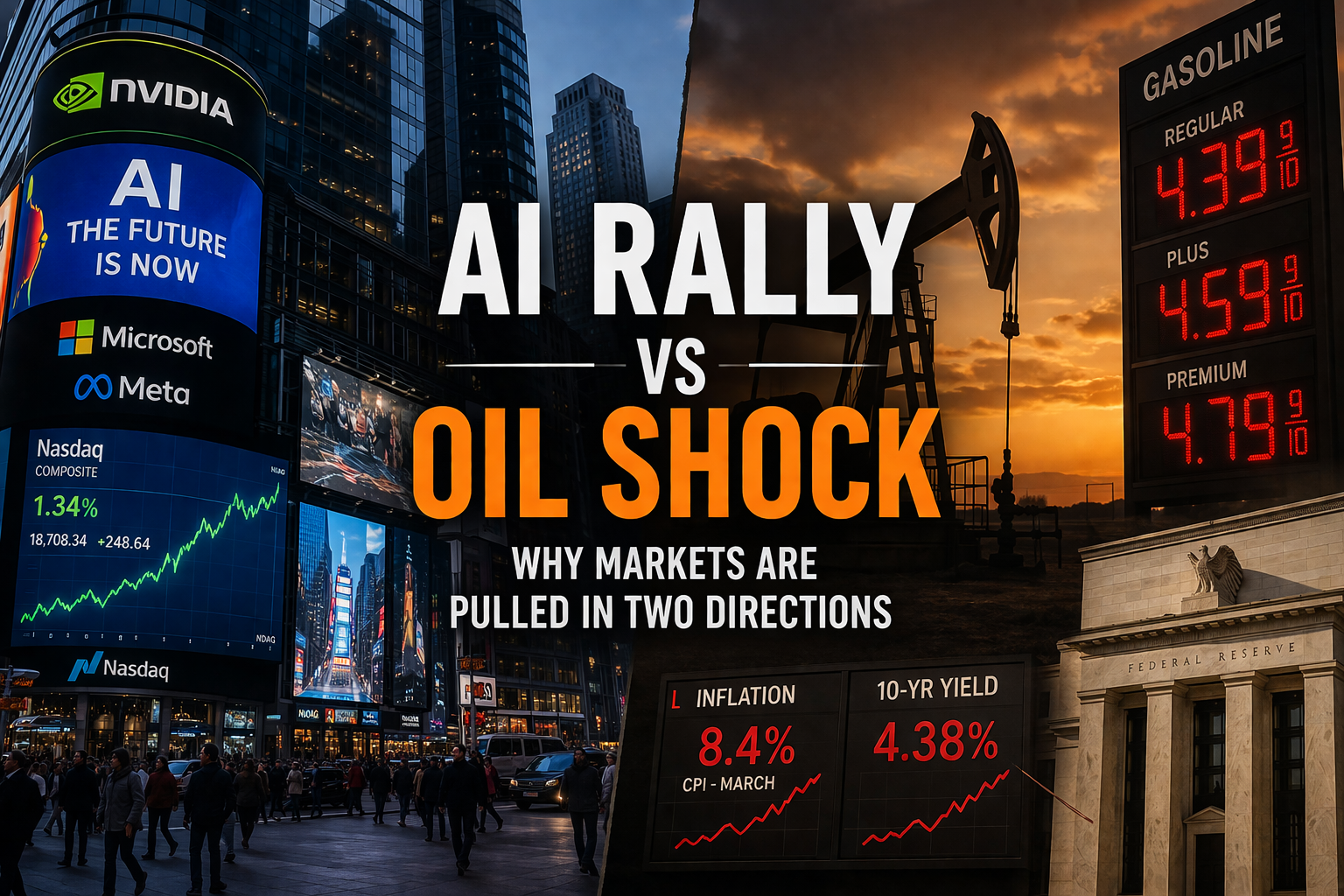
AI Rally vs Oil Shock: Why Markets Are Being Pulled in Two Directions
Market News Explainer
Markets are being pulled in two very different directions: artificial intelligence is keeping investor confidence alive, while rising oil prices and inflation worries are making investors more cautious.
This is one of the most important market stories right now because it explains why stocks can look strong on the surface while serious risks are building underneath.
On one side, investors are still excited about AI. Big technology companies are spending huge amounts of money on chips, data centres, cloud infrastructure, and AI products. That spending has helped support technology stocks and keep market sentiment positive.
On the other side, oil prices, inflation pressure, and central bank uncertainty are creating a very different problem. If energy prices stay high, inflation can become harder to control. If inflation stays high, central banks may delay rate cuts or even sound more hawkish.
In simple terms, the market is asking one big question: can the AI boom stay strong enough to outweigh the pressure from oil, inflation, and interest rates?
Useful sources for this market story
Helpful outbound links:
Reuters: Meta raises $25 billion in bond sale after lifting AI spending plan
Reuters: Investors brace for oil shock risk
Reuters: Fed caution after inflation data
AP News: AI stocks and rising oil weigh on Wall Street
Related guides on The Trading Journal
Helpful internal links:
Nvidia Earnings 2026: Can AI Demand Sustain Its Massive Growth?
How Interest Rates Affect the Stock Market
How to Start Investing for Beginners
What Is Dollar-Cost Averaging?
The Beginner's Guide To Personal Finance
Why AI is still driving market optimism
Artificial intelligence remains one of the biggest forces in the stock market because investors believe it could transform how companies operate, sell products, analyse data, automate tasks, and build new services.
The AI trade is not only about software companies. It now includes chipmakers, cloud providers, data-centre companies, power infrastructure, networking firms, and businesses that supply equipment for AI buildouts.
This matters because AI spending creates a chain reaction across the market. If a major technology company spends billions on AI infrastructure, that money flows into chips, servers, energy systems, cloud platforms, and construction.
- Chipmakers benefit from demand for AI processors
- Cloud providers benefit from demand for computing power
- Data-centre companies benefit from infrastructure expansion
- Energy and power-equipment firms may benefit from rising electricity demand
- Software companies may benefit if AI products create new revenue
That is why AI has become more than a technology story. It is now a market-wide investment theme.
Why Big Tech spending matters
One reason investors are still confident in AI is that major technology companies are backing the trend with real money. When companies spend aggressively on AI infrastructure, markets see that as a sign that management teams expect future demand.
Meta’s recent bond sale is a good example. The company raised billions in debt after lifting its AI spending plan, showing that the AI buildout is becoming expensive enough that even cash-rich technology giants may use the bond market to help fund it.
The key market idea is simple: AI optimism is no longer based only on hype. Investors are watching actual spending, earnings, and infrastructure demand.
But there is a risk: AI spending has to pay off
The bullish case for AI is that companies are investing heavily now because future profits could be much larger later.
The risk is that spending rises faster than profits. If companies spend hundreds of billions on AI infrastructure but the financial return takes longer than expected, investors may become less patient.
This is why earnings reports from major AI-related companies matter so much. Investors are not only looking for revenue growth. They are looking for proof that AI demand is becoming real business value.
- Are AI products creating real revenue?
- Are cloud customers spending more because of AI?
- Are chip orders still strong?
- Are margins holding up despite higher spending?
- Are companies giving confident guidance for the next quarter?
Why oil prices are making investors nervous
While AI is helping the market look strong, oil is creating the opposite effect. Rising oil prices can damage market confidence because energy is connected to almost everything.
Oil affects transport, manufacturing, shipping, airline costs, consumer fuel prices, and inflation expectations. If oil prices rise sharply and stay high, businesses and households can both feel pressure.
Simple example:
If fuel becomes more expensive, delivery costs can rise. If delivery costs rise, businesses may raise prices. If prices rise across the economy, inflation becomes harder to control.
That is why oil is not just an energy story. It is also an inflation story, a consumer story, and a central bank story.
How oil can affect the stock market
Oil can affect different parts of the stock market in different ways. Energy producers may benefit from higher prices, but many other companies can suffer from higher costs.
- Airlines may face higher fuel costs
- Retailers may face higher shipping and supply-chain costs
- Consumers may have less money left after paying for fuel and bills
- Manufacturers may face higher production costs
- Central banks may become more cautious if inflation rises
This is why the same oil move can create winners and losers. Energy stocks may rise while consumer, travel, or rate-sensitive stocks come under pressure.
The inflation problem
Inflation is one of the biggest reasons markets care about oil. If inflation is already above target, rising energy prices can make the problem worse.
When inflation remains stubborn, central banks have less room to cut interest rates. That matters because lower rates usually support stocks by making borrowing cheaper and future profits more valuable.
Think about it:
If inflation is falling, investors may expect rate cuts. If oil pushes inflation higher again, those rate-cut hopes can fade quickly.
Why central banks are important right now
Central banks are important because they influence interest rates. Interest rates affect borrowing costs, mortgages, credit cards, business investment, bond yields, and stock valuations.
If central banks sound cautious because inflation is still too high, investors may become less willing to pay high prices for stocks. This is especially important for growth stocks, including many technology and AI names.
That creates a difficult situation for markets. AI companies may be growing quickly, but if interest rates stay higher for longer, investors may still question how much they should pay for that growth.
Why the market can rise even when risks are high
One confusing thing for beginners is that the stock market can rise even when the news looks worrying.
This happens because markets are forward-looking. Investors are constantly comparing good news and bad news, then deciding which side matters more.
Right now, strong earnings and AI optimism may be enough to support parts of the market. But that does not mean risks have disappeared.
Key idea:
A rising market does not always mean the economy is risk-free. It can simply mean investors believe the positives are stronger than the negatives for now.
The market is becoming narrow
Another important point is market concentration. When a small group of large technology companies drives most of the gains, the overall index can look healthier than the average stock.
This matters because a narrow rally can become fragile. If the biggest AI and technology names disappoint investors, the wider market may have less support.
- A few large companies can lift the whole index
- Smaller companies may not benefit equally
- Investors may become too dependent on AI leaders
- A disappointment from one megacap stock can affect market sentiment
What investors are watching next
Investors are likely to watch three main areas: company earnings, oil prices, and central bank language.
Earnings will show whether companies are still growing strongly. Oil prices will show whether inflation pressure may worsen. Central bank comments will show whether rate cuts are still realistic or becoming less likely.
- AI company earnings and forward guidance
- Big Tech capital spending plans
- Oil prices and energy supply risks
- Inflation reports
- Federal Reserve, Bank of England, and European Central Bank comments
- Bond yields
- Consumer spending data
- Jobs market data
What this means for everyday investors
For everyday investors, this kind of market environment can be confusing. AI headlines can make it feel like stocks can only go up, while oil and inflation headlines can make it feel like a crash is always around the corner.
The truth is usually more balanced. Markets can remain strong for longer than expected, but they can also change quickly when expectations shift.
This is why beginners should avoid making emotional decisions based on one headline. A strong investing approach usually focuses on risk, diversification, time horizon, and consistency.
Important:
Market news is useful, but it should not replace a personal investment plan. News explains what is happening. Your plan decides how you respond.
Could AI still carry the market higher?
Yes, AI could still support the market if earnings continue to improve and companies show that their AI investments are producing real returns.
If chip demand remains strong, cloud spending continues, and major companies keep reporting growth from AI-related products, investors may stay optimistic.
The bullish argument is that AI is not a short-term trend but a long-term infrastructure shift, similar to the early internet or cloud computing.
Could oil and inflation stop the rally?
Yes, oil and inflation could slow or reverse the rally if they become serious enough.
If oil prices stay high, inflation could remain sticky. If inflation remains sticky, central banks may keep interest rates high. If rates stay high, stock valuations can come under pressure.
This does not mean stocks must crash. It means the market has less room for disappointment.
The simple explanation
The easiest way to understand the current market is this:
- AI is giving investors a reason to buy stocks
- Oil is giving investors a reason to worry about inflation
- Inflation is making central banks cautious
- Higher rates can pressure stock valuations
- Strong earnings can still support the market
- The market is trying to decide which force is stronger
This is not simply a good market or a bad market. It is a split market where powerful optimism and serious risk are happening at the same time.
Final thoughts
The current market story is not just about AI stocks rising or oil prices moving higher. It is about a bigger battle between growth optimism and inflation pressure.
AI is giving investors hope that future earnings can keep improving. Oil is reminding investors that inflation and geopolitics can still disrupt the outlook.
For beginners, the lesson is simple: markets are rarely driven by one thing. A strong market can still have risks, and a risky market can still have opportunities.
Right now, investors are not just asking whether AI can grow. They are asking whether AI growth can stay strong enough to overcome oil, inflation, and higher-for-longer interest rates.