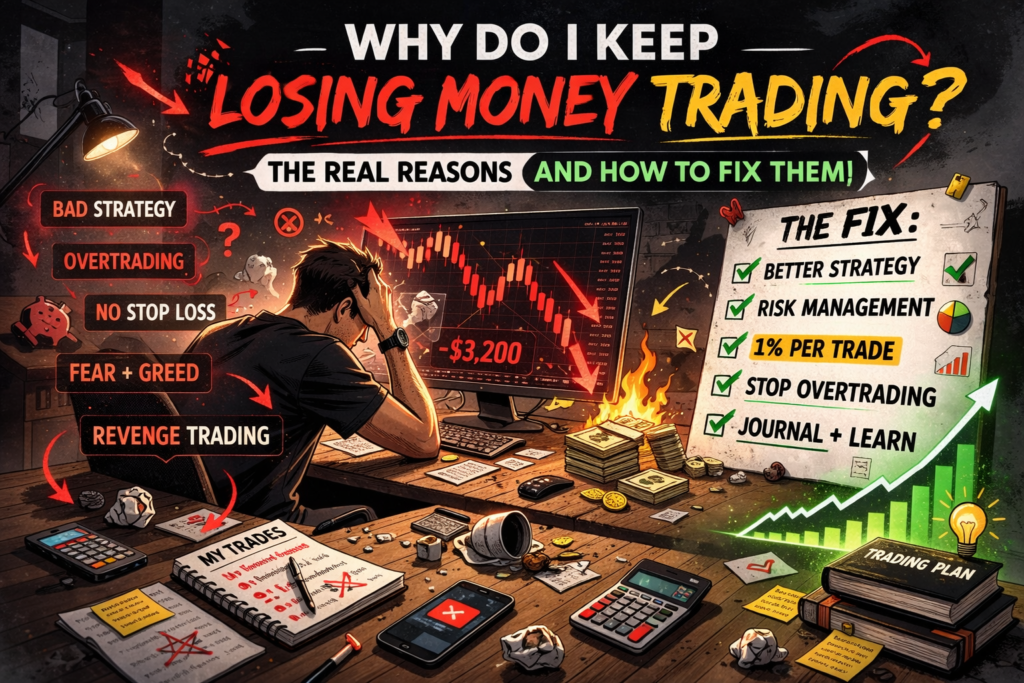
If you keep losing money in trading, it usually isn’t because you’re “unlucky” or because the market is “rigged.” Most of the time it’s one (or a few) predictable problems that show up again and again in beginner accounts.
The good news: if the reasons are predictable, they’re fixable.
Below is a detailed breakdown of the main causes—plus practical fixes you can apply immediately.
1) You Don’t Have a Real Edge (You’re Basically Guessing)
A lot of traders think they have a strategy, but what they really have is a “setup vibe.”
A real edge means:
- you know exactly what conditions must be present to enter
- you know where the trade is invalidated (stop loss)
- you know why price should move your way
- you can test it over many trades
Signs you don’t have an edge:
- you can’t explain your strategy in 3–5 rules
- your entries are different every time
- you change rules mid-trade
Fix:
- Write a simple strategy checklist (max 5 entry rules).
- Backtest 50–100 examples on one market (even manually).
- Track results: win rate, average win, average loss.
2) Your Risk Management Is Broken (This One Alone Can Kill You)
Even with a decent strategy, bad risk management will wipe you out.
Common mistakes:
- risking too much per trade
- moving stop losses
- taking random position sizes
- revenge trading after losses
Fix (simple rule):
- Risk 1% or less per trade as a beginner (even 0.5% is fine).
- Set your stop loss first, then calculate your position size.
- Never increase risk because you’re “sure.”
If you want a simple mindset:
Your job isn’t to make money today. Your job is to not blow up.
3) Your Risk-to-Reward Is Too Small (You Need Too Many Wins)
If you risk £100 to make £50, you must win a lot just to break even.
A lot of beginners:
- take profits early
- let losses run
- end up with a terrible payoff ratio
Fix:
Aim for something like:
- 1:2 minimum for most setups
- 1:3 or 1:4 if your strategy supports it (like your reversal/liquidity style)
Even if your win rate is only 40%, with a strong reward-to-risk you can still be profitable.
4) You’re Trading the Wrong Conditions (Bad Market = Bad Results)
Many strategies only work in certain environments:
- trending markets
- range-bound markets
- high volatility sessions
- low volatility sessions
Beginners lose because they try to force trades when the market is dead or choppy.
Fix:
Add a “market filter” rule such as:
- only trade during high-liquidity sessions
- only trade when price is near a key level
- avoid news spikes if your strategy can’t handle them
- skip days when structure is unclear
Sometimes the best trade is:
no trade.
5) You’re Overtrading (Too Many Trades = Too Many Mistakes)
Overtrading usually happens when:
- you’re bored
- you want to “make something happen”
- you’re trying to win back losses
- you don’t have strict entry criteria
The result:
- lower quality trades
- more fees/spread cost
- more emotional decisions
Fix:
Give yourself a hard rule:
- max 1–3 trades a day
- or “only take A+ setups”
- or “only take trades that meet all checklist rules”
6) You’re Letting Emotions Control Execution (The Silent Killer)
Even with a good plan, emotions ruin execution:
- fear makes you close winners early
- greed makes you hold too long
- anger makes you revenge trade
- anxiety makes you move stops
Fix:
Use “set and forget” rules:
- enter only when checklist is met
- place stop loss + take profit immediately
- do not touch the trade unless your rules say so
- journal after the trade, not during it
If your emotions are high, your account is in danger.
7) You’re Not Accounting for Spreads, Fees, and Slippage
Beginners often ignore the “cost of trading”:
- spread eats small targets
- slippage hits during volatility
- fees add up when overtrading
This is especially brutal if you scalp tiny moves.
Fix:
- Make sure your target is large enough to justify the cost.
- Avoid low-liquidity times.
- Use realistic backtesting assumptions.
8) You’re Not Reviewing Your Trades (So You Repeat Mistakes)
If you’re not journaling and reviewing, you’re basically doing the same thing and hoping for different results.
Fix:
Journal just these 6 things:
- setup type
- entry reason (checklist)
- stop loss reason (invalidation)
- target reason
- result (R multiple)
- mistake (if any)
After 20 trades, patterns appear fast.
9) You Expect Daily Profit (That Expectation Forces Bad Trades)
The market doesn’t pay you because you showed up.
Beginners lose because they:
- feel they “must trade”
- chase setups
- force entries
- treat trading like a job clocking in
Fix:
Shift the goal from:
- “make money today”
to: - “execute perfectly today”
Profits follow execution, not the other way around.
The 7-Day Fix Plan (Simple and Effective)
If you want a practical “reset,” do this:
Day 1–2: Simplify
- Pick one market
- Pick one setup
- Write 5 entry rules
Day 3–4: Risk rules
- Risk 0.5%–1%
- Set SL/TP before entry
- No moving stops
Day 5–6: Trade less
- Max 1–2 trades/day
- Only A+ setups
- Skip messy days
Day 7: Review
- Review 10–20 trades
- Identify top 2 mistakes
- Create rules to prevent them
Bottom Line
You keep losing money because something is off in one of these core areas:
- no tested edge
- poor risk management
- weak risk-to-reward
- trading the wrong conditions
- overtrading
- emotional execution
- no review process
Fix those, and trading stops feeling like gambling.