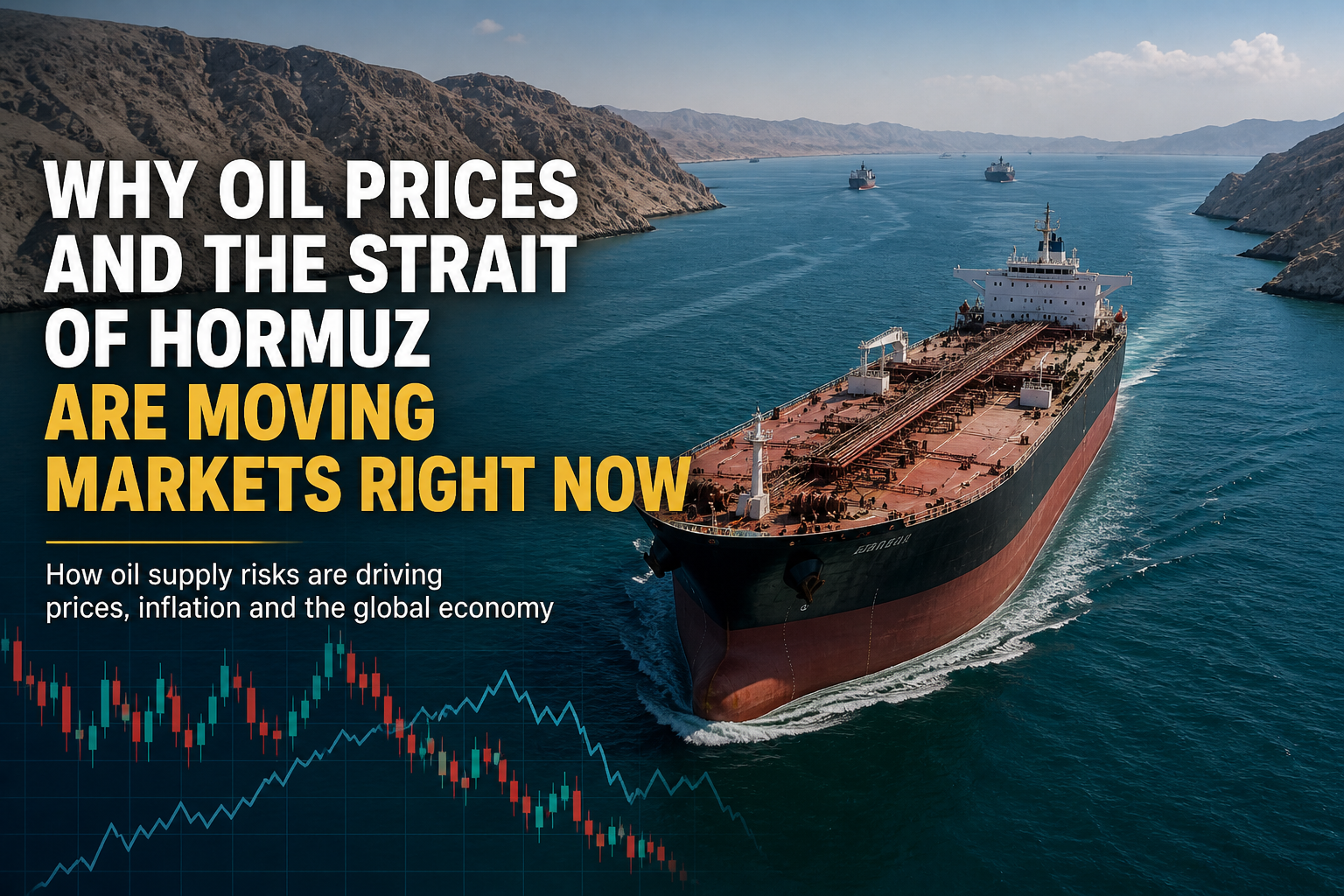
Why Oil Prices and the Strait of Hormuz Are Moving Markets Right Now
Market News
Oil prices are back at the centre of market attention, and one of the biggest reasons is the Strait of Hormuz. When this route is disrupted, investors quickly start worrying about inflation, supply chains, economic growth, and the stock market.
If you have followed market news recently, you may have noticed that investors are paying close attention to energy prices again. Oil matters because it does not only affect petrol prices. It also affects transport, shipping, production costs, inflation, and business confidence.
Think about it:
If the cost of moving goods, running factories, and transporting fuel all rise at the same time, what happens to prices across the wider economy?
What you will learn
- What the Strait of Hormuz is
- Why it matters so much to global markets
- Why oil prices are moving
- How higher oil prices affect inflation
- How energy shocks affect stocks and interest rates
- Why some sectors react differently from others
- What investors are watching right now
What is the Strait of Hormuz?
The Strait of Hormuz is one of the most important shipping routes in the world for energy markets. It is a narrow passage that connects major oil-producing countries in the Gulf to global markets.
A huge amount of oil and gas moves through this route. That is why any disruption there can quickly affect energy prices worldwide.
Key idea:
The Strait of Hormuz matters because it is a vital energy chokepoint. If traffic through it is disrupted, global oil and gas supply can be affected very quickly.
Why are markets so focused on it right now?
Markets are focused on the Strait of Hormuz because geopolitical tensions have increased fears of supply disruption. When traders believe oil supply could be reduced, prices can move sharply higher.
Higher oil prices matter because they can feed into inflation, raise business costs, and increase pressure on central banks. This is why a geopolitical story can quickly become a market story.
Simple example:
If oil becomes more expensive, transport companies pay more, manufacturers pay more, airlines pay more, and consumers often end up paying more too.
Why do oil prices matter so much?
Oil is a key input across the economy. It affects transport, logistics, manufacturing, travel, utilities, and many everyday goods. When oil prices rise sharply, the effects can spread across many industries.
This is why investors do not treat oil as just another commodity. It often acts like a signal for inflation risk and economic pressure.
When oil prices rise quickly, markets often start asking the same questions: Will inflation stay higher? Will consumers spend less? Will central banks stay tougher for longer?
How higher oil prices affect inflation
Inflation is the rate at which prices rise over time. Oil can contribute to inflation because higher energy costs feed into transport, goods production, and business expenses.
If businesses face higher costs, some of those costs may be passed on to customers. That can keep inflation more stubborn than policymakers would like.
Check your understanding:
Why can higher oil prices increase inflation?
Answer: Because energy is used across the economy, so higher oil prices can push up transport, production, and consumer prices.
How oil prices affect interest rate expectations
When inflation risks rise, investors start thinking about central banks. If oil prices keep inflation elevated, central banks may be less willing to cut interest rates quickly.
That matters because interest rates affect borrowing costs, company valuations, consumer demand, and investor sentiment.
Key idea:
Oil prices can influence market expectations about interest rates, not because oil sets rates directly, but because oil can change the inflation outlook.
How oil shocks affect the stock market
The stock market does not react to higher oil prices in one simple way. Some companies and sectors may suffer because costs rise or consumers cut spending. Others may benefit, especially energy producers.
- Airlines may face higher fuel costs
- Transport and logistics firms may see pressure on margins
- Retailers may be hurt if consumers have less money to spend
- Manufacturers may face more expensive inputs
- Oil and energy companies may benefit from stronger prices
Potential losers:
Companies that depend heavily on fuel, transport, or price-sensitive consumers may feel pressure when oil rises.
Potential winners:
Energy producers and some commodity-linked businesses may benefit if oil prices stay elevated.
Why markets can still rise even when oil is a problem
One thing that can confuse beginners is that markets do not always fall when oil rises. Sometimes stocks remain strong because investors are also watching earnings, technology growth, AI demand, or hopes that the disruption may not last.
Markets price many factors at the same time. So even if oil is a major risk, strong corporate earnings or optimism in another part of the market can still support major indexes.
Common mistake:
Do not assume one headline explains everything in the market. Oil may be a major factor, but stocks are also influenced by earnings, interest rates, economic data, and investor expectations.
What investors are really watching
Investors are not only watching oil prices themselves. They are also watching how long disruption lasts, whether inflation data worsens, how bond yields react, and what central banks say next.
- Is oil still rising or starting to stabilise?
- Are shipping routes still disrupted?
- Is inflation becoming more persistent?
- Are central banks sounding more cautious on rate cuts?
- Are companies warning about higher costs?
- Are stock markets shrugging it off or starting to react?
Try this:
The next time you see a headline about oil prices, do not stop there. Ask what it could mean for inflation, interest rates, company profits, and the sectors you follow.
Why this matters for ordinary people too
This story is not only about traders or investors. Higher oil prices can affect petrol, heating, flights, deliveries, food costs, and the wider cost of living.
That is why energy stories matter beyond the financial pages. What happens in global oil markets can eventually affect household budgets and consumer confidence.
When energy prices rise, the story can quickly move from global markets to everyday money.
Quick recap
- The Strait of Hormuz is a major global energy shipping route
- Disruption there can push oil and gas prices higher
- Higher oil prices can increase inflation pressure
- Inflation pressure can affect interest rate expectations
- Some stock market sectors suffer while others may benefit
- Markets also react to earnings, expectations, and how long the disruption may last
- This story matters for both investors and households
Mini quiz
Question 1:
Why is the Strait of Hormuz so important?
Answer: Because it is a major route for global oil and gas shipments.
Question 2:
How can higher oil prices affect inflation?
Answer: By raising costs across transport, production, and the wider economy.
Question 3:
Do all stocks react to higher oil prices in the same way?
Answer: No. Some sectors may struggle while energy-related stocks may benefit.
Final thoughts
The reason oil prices and the Strait of Hormuz are moving markets right now is simple: energy disruptions can ripple through inflation, interest rates, company profits, and consumer spending.
This is one of those market news stories that matters because it connects geopolitics, inflation, central banks, stocks, and everyday costs all in one chain.
For beginners, this makes it a very useful market story to understand. Once you see how oil connects to the wider economy, market headlines start to make much more sense.