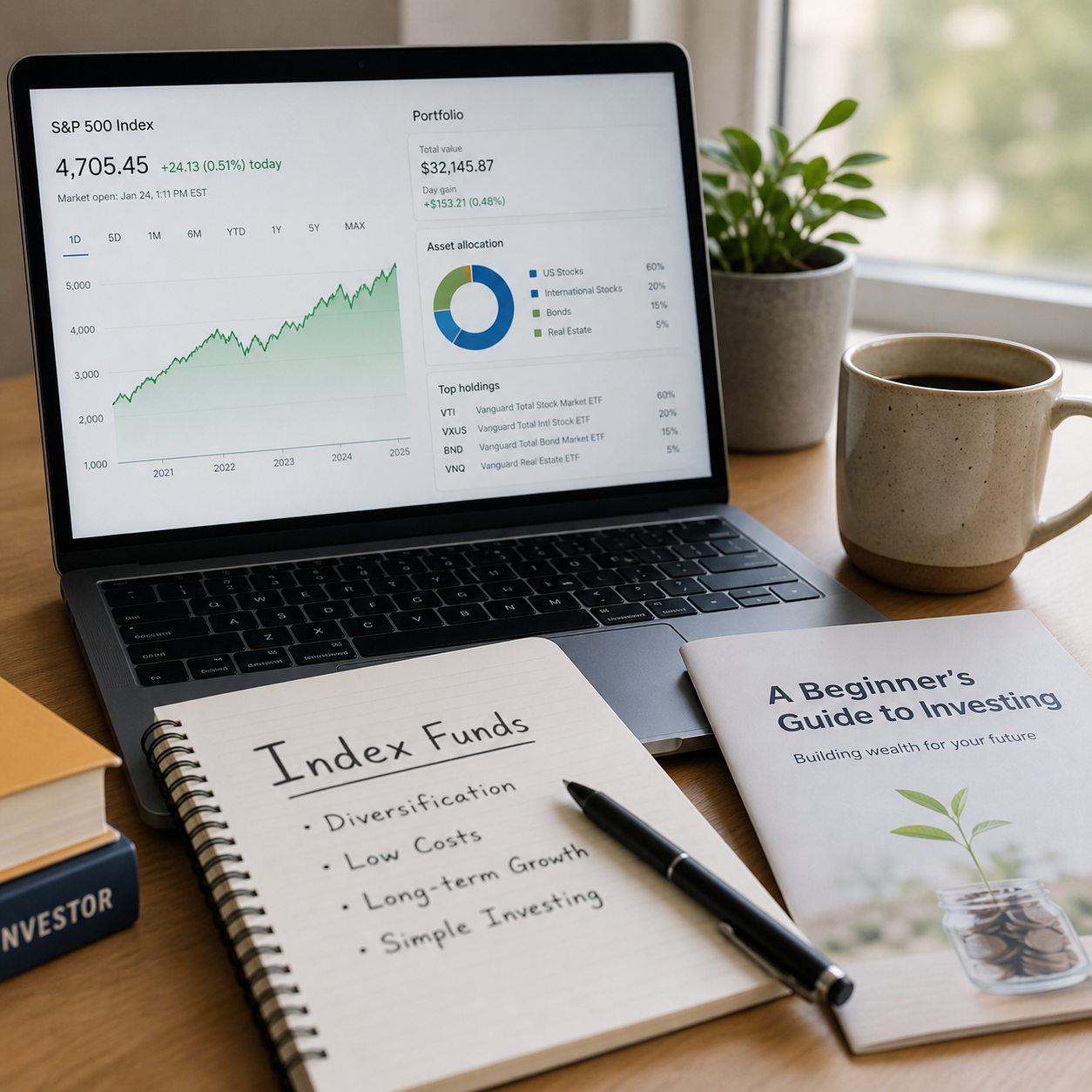
What Are Index Funds? A Simple Beginner’s Guide
Investing Guide
Index funds are one of the simplest ways beginners can start understanding long-term investing. Instead of trying to pick individual winning stocks, an index fund lets you invest in a broad group of companies through one fund.
For many beginners, investing feels confusing because there are thousands of stocks, endless opinions, and constant market news. Index funds help simplify the process by giving investors exposure to a whole market or section of the market without needing to choose every company individually.
Think about it:
If you do not know which single company will perform best over the next 10 years, would it be easier to own a small piece of many companies instead?
What you will learn
- What index funds are
- How index funds work
- Why beginners often like them
- The difference between index funds and individual stocks
- Why fees matter
- The risks of index fund investing
- How index funds can fit into a long-term investing plan
Before you start:
This article is educational only and should not be treated as personal financial advice. Investing involves risk, and the value of investments can rise or fall.
What is an index fund?
An index fund is an investment fund that aims to follow the performance of a market index. A market index is a collection of investments used to represent a particular market, country, sector, or group of companies.
Instead of a fund manager trying to choose the best individual stocks, an index fund usually tracks a set list of companies. This is why index funds are often linked with passive investing.
Key idea:
An index fund does not usually try to beat the market. It tries to follow the market.
How does an index fund work?
An index fund works by holding investments that match, or closely match, a chosen index. If the index contains a group of large companies, the fund will usually hold those companies in similar proportions.
When the companies in the index rise in value, the fund may rise too. When the index falls, the fund can fall as well.
Simple example:
If an index tracks 500 large companies, an index fund following that index gives you exposure to those companies through one investment product rather than buying each stock separately.
Why are index funds popular?
Index funds are popular because they are simple, diversified, and often lower cost than many actively managed funds. They are especially attractive to people who want to invest for the long term without constantly picking stocks or reacting to daily market news.
- They are usually easy to understand
- They can provide instant diversification
- They often have lower fees
- They reduce the need to pick individual stocks
- They can suit long-term investors
- They make investing feel more manageable for beginners
For many beginners, the biggest benefit of index funds is simplicity. They allow investors to focus on consistency instead of constantly guessing which stock will win next.
Index funds vs individual stocks
Buying an individual stock means buying a small part of one company. If that company performs well, your investment may rise. If it performs badly, your investment may fall heavily.
An index fund spreads your money across many investments. This can reduce the risk of depending too much on one company.
Individual stocks:
More control, but higher risk if your money is concentrated in only a few companies.
Index funds:
Less control over individual companies, but usually broader diversification through one fund.
Check your understanding:
Which is usually more diversified: owning one company stock or owning an index fund with hundreds of companies?
Answer: The index fund, because it spreads money across many companies.
What is diversification?
Diversification means spreading your money across different investments instead of putting everything in one place. It is one of the most important ideas in investing.
If you own only one stock and that company struggles, your portfolio can be badly affected. If you own a fund with many companies, one poor performer may have less impact on the whole investment.
Key idea:
Diversification does not remove risk, but it can reduce the damage caused by relying too heavily on one company, one sector, or one investment idea.
Why fees matter
Fees are one of the most important things beginners should understand. Investment fees may look small, but over many years they can reduce your returns.
Index funds often have lower fees than actively managed funds because they are designed to follow an index rather than pay managers to make regular stock-picking decisions.
Important:
A small difference in fees can become meaningful over a long investing period. Lower fees do not guarantee better results, but high fees need to be justified.
- Fund management fees
- Platform fees
- Trading or dealing fees
- Foreign exchange fees
- Account fees
Are index funds safe?
Index funds are not risk-free. They can still fall in value if the market they track falls. A broad index fund may reduce company-specific risk, but it does not remove market risk.
For example, if the overall stock market falls during a recession or market downturn, an index fund following that market can fall too.
Index funds can make investing simpler, but they do not make investing risk-free.
Why time horizon matters
Your time horizon is how long you plan to leave your money invested before needing it. This matters because index funds can rise and fall in the short term.
Money needed soon is usually better kept in savings or lower-risk options. Money for long-term goals may be better suited to investing, depending on your situation and risk tolerance.
- Short-term money usually needs stability
- Long-term money has more time to recover from downturns
- Market falls are normal during long investing periods
- A longer time horizon can make volatility easier to manage
Try this:
Before investing, ask yourself when you might need the money. If the answer is very soon, investing may not be the right place for it.
Index funds and compound growth
Compound growth is when your returns start earning returns of their own. This is one of the main reasons long-term investing can become powerful over time.
If an investor regularly adds money to an index fund and leaves it invested for many years, growth can build on previous growth. The effect is not guaranteed, but time and consistency can make a big difference.
Simple example:
If your investment grows and you leave the gains invested, future growth can happen on both your original money and the gains already made.
What is the difference between an index fund and an ETF?
Beginners often see the terms index fund and ETF together. They are related, but not always the same thing.
An index fund is a fund designed to track an index. An ETF, or exchange-traded fund, is a type of fund that trades on a stock exchange like a share. Many ETFs are index-tracking funds, but not every fund is an ETF.
Index fund:
A fund that aims to track a market index.
ETF:
A fund that trades on an exchange, often throughout the trading day, similar to a stock.
Why beginners often choose broad index funds
Broad index funds are popular because they spread money across a wide range of companies. This can be easier for beginners than trying to analyse individual businesses.
Instead of asking, “Which single company will win?”, the investor is asking, “Do I want exposure to this broader market over the long term?”
Think about it:
If you believe businesses and markets can grow over many years, owning a broad basket of companies may feel more sensible than relying on one perfect stock pick.
Common index fund mistakes
- Thinking index funds cannot lose money
- Investing money needed in the short term
- Choosing funds without understanding what they track
- Ignoring fees
- Selling in panic during normal market downturns
- Buying too many funds that overlap heavily
- Assuming past performance guarantees future results
Common mistake:
Some beginners buy several different funds thinking they are diversified, but many funds may hold the same large companies. This can create overlap without adding much real diversification.
How index funds can fit into a long-term plan
Index funds can be useful as part of a long-term investing plan. They are not exciting in the same way as trying to find the next big stock, but that is exactly why many people like them.
A simple long-term plan might focus on regular contributions, low fees, diversification, patience, and avoiding emotional decisions during market swings.
Beginner takeaway:
Index funds are often used by investors who want a simple, diversified, long-term approach rather than constant stock picking.
Questions to ask before choosing an index fund
- What index does the fund track?
- What companies or assets are inside it?
- How much are the fees?
- Is it suitable for my time horizon?
- Does it overlap with investments I already own?
- Can I handle the risk if the market falls?
- Does it match my long-term goal?
Try this:
Before choosing any fund, read what it actually tracks. A fund name can sound simple, but the holdings inside matter.
Quick recap
- An index fund tracks a market index
- It usually aims to follow the market, not beat it
- Index funds can provide broad diversification
- They are often lower cost than actively managed funds
- They can still fall in value
- They usually suit long-term goals better than short-term needs
- Fees, time horizon, and risk still matter
Mini quiz
Question 1:
Does an index fund usually try to beat the market?
Answer: No. It usually tries to track the market or a chosen index.
Question 2:
Are index funds risk-free?
Answer: No. They can still fall if the market they track falls.
Question 3:
Why do fees matter?
Answer: Because fees reduce returns, and their impact can grow over long periods.
Question 4:
Why do beginners often like index funds?
Answer: Because they are simple, diversified, and often lower cost than many actively managed options.
Final thoughts
Index funds are not a shortcut to guaranteed wealth, but they can make investing simpler and more accessible for beginners. They offer a way to invest in a broad market without needing to pick every individual stock.
The power of index funds is not that they are exciting. It is that they can make long-term investing simpler, more diversified, and easier to stay consistent with.
For beginners, understanding index funds is a strong step toward building a sensible investing foundation. Once you understand how they work, it becomes easier to think clearly about diversification, risk, fees, and long-term wealth building.