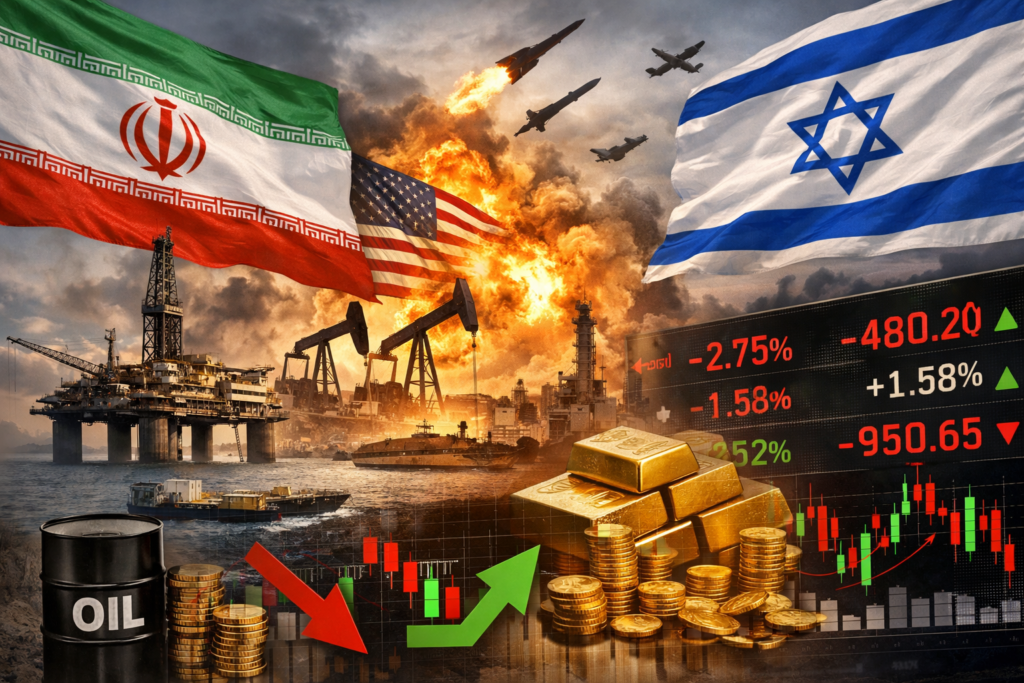
The ongoing escalation between the United States, Israel, and Iran has quickly become one of the most watched geopolitical events of 2026 — not just for its political ramifications, but for its growing impact on global financial markets. Since US and Israeli forces launched coordinated strikes on Iran, markets worldwide have reacted sharply across energy, commodities, equities, currencies, and risk sentiment.
Below, we break down the most current developments, why markets are moving, and what this could mean for investors in the weeks ahead.
📌 What’s Happened So Far
In late February 2026, coordinated strikes by the United States and Israel hit Iranian military infrastructure and leadership sites, resulting in significant escalation in the Middle East. Iran responded rapidly with missile and drone attacks on US bases and allied territories across the Gulf region. The situation intensified as reports emerged of attacks in the United Arab Emirates, Qatar, Bahrain, Kuwait, and other adjacent areas.
Amid rising tensions, Iranian authorities have taken steps that have effectively disrupted vessel traffic through the Strait of Hormuz, a vital chokepoint through which approximately 20% of global oil trade passes. Although official closure has not been declared, many commercial tankers are either avoiding the route or anchoring offshore due to increased risk and rising insurance premiums.
This is particularly significant because disruptions in the Strait — even partial — can sharply tighten energy supply channels, influencing commodity prices and inflation expectations worldwide.
🛢 Impact on Energy Markets
Oil Prices Soar
Energy markets have been one of the earliest and most direct barometers of the conflict’s economic impact.
- Brent crude prices jumped sharply — at times rising 10–13% — driven by supply fears as shipping through the Strait of Hormuz became limited.
- Natural gas prices also experienced significant spikes, especially after attacks and production disruptions were reported in Qatar.
Because around a fifth of the world’s oil and LNG supply relies on Middle Eastern shipments, even a short-lived disruption can create ripple effects in energy costs globally.
Inflationary Pressures Rise
Higher oil and gas prices have immediate knock-on effects:
- Increased fuel and transport costs
- Rising production and distribution costs for goods
- Higher input costs for industries reliant on energy
This in turn keeps inflationary pressure elevated, complicating central banks’ efforts to balance growth and price stability.
📉 Equity Markets Under Pressure
Equity markets have broadly reacted with risk-off sentiment:
- Major European indices, including the Euro Stoxx 50, DAX 30, and CAC 40, opened lower as investors priced in heightened geopolitical risk.
- US futures also dipped, with key indices like the S&P 500 and NASDAQ declining amid uncertainty.
- Even regional exchanges in the Gulf (e.g., Abu Dhabi and Dubai markets) were temporarily shut to prevent panic selling.
Energy, defence, and precious metals stocks have fared relatively better, reflecting an instinctive shift toward sectors perceived as safer in times of geopolitical stress. Meanwhile, cyclical and consumer sectors have seen broader selling pressure.
🪙 Commodities: Gold, Oil & Safe-Haven Flows
Gold Surges
As with many geopolitical crises, gold has attracted investor demand as a traditional safe-haven asset:
- Prices of bullion and gold-linked instruments have climbed, reflecting capital flows away from riskier assets.
- Analysts note that gold’s strength is closely correlated with risk appetite, and in highly uncertain environments, bullion often outperforms more volatile financial assets.
Oil Continues to React
Oil is not just reacting to geopolitical headlines — it is also sensitive to supply chain interruptions and shipping risk premiums, which push prices higher even without direct infrastructure damage.
💹 Currencies & Bonds
Heightened geopolitical risk typically benefits currencies and assets considered safe havens, such as:
- The US dollar, which historically strengthens during times of global risk aversion.
- Government bonds in stable economies, although rising energy costs can also push yields higher if inflation expectations increase.
Oil-producing nations’ currencies, like the Canadian dollar or Middle Eastern currencies, may see a strengthening trend if energy revenues rise, but conflict proximity can complicate this dynamic.
📊 Broader Macroeconomic Implications
Inflation vs. Interest Rates
Energy cost inflation could:
- Delay potential interest rate cuts by major central banks
- Force policymakers to maintain tighter monetary conditions
- Suppress consumer spending and slow broader economic growth
Central banks, such as the Bank of England and the US Federal Reserve, now face a delicate balancing act between containing inflation and supporting economic activity.
Trade & Growth
Disrupted energy flows also affect global trade patterns. Higher transportation costs and elevated commodity prices can dampen global economic output — particularly in energy-importing nations.
📌 What Investors Should Watch Next
While the situation remains fluid, markets are monitoring several key indicators:
- Strait of Hormuz Shipping Activity — Any shift toward full closure would have immediate global energy implications.
- Oil & Gas Supply Reports — Production levels, OPEC+ output decisions, and strategic reserves utilization will all shape commodity prices.
- Central Bank Communications — Any shift in inflation expectations or rate policy in response to geopolitical inflationary pressures.
- Risk Asset Sentiment — Continued equity market volatility could signal broader economic stress.
🔎 Conclusion
The US–Israel–Iran conflict has emerged as a major geopolitical stressor influencing global financial markets in early 2026. From surging oil and gas prices to risk-off movements in equities, commodities, and currencies, investors are recalibrating exposure amid heightened uncertainty.
While the extent and duration of the conflict remain unpredictable, its early market impacts — including inflationary pressures, safe-haven demand, and volatile energy prices — are becoming clear.
Staying informed and monitoring key economic indicators will be essential for navigating these evolving conditions in the weeks ahead.